How we respond in a time of crisis says a lot about who we are both individually and as a collective. Can we band together to try and help? And how long will that sense of togetherness actually last? But we already know the answer to that, don’t we? Because unfortunately living through a time of plague, quarantine, the search for a cure, attempted containment, the whole lot isn’t a hypothetical, it was a reality for us all a mere six years ago. Albert Camus’s novel “La Peste”, adapted to the play The Plague by Neil Bartlett, is looking at a whole other type of plague within his society, and yet the events of The Plague read like 2020’s headlines.
It starts with the rats. Folks start seeing more and more of them, and the ones they see are dead or dying, the tell-tale blood spots surrounding their mouths. The town’s doctor is the first to notice, and though he tries to alert the custodian of his building right away, it’s initially thought to be a prank. However, as the number of dead rats grows, people begin to become alarmed. It’s only once it starts to spread to humans that the doctor is finally taken seriously. But is it already too late? What damage has been done while the folks trying to help wade through bureaucratic red tape?
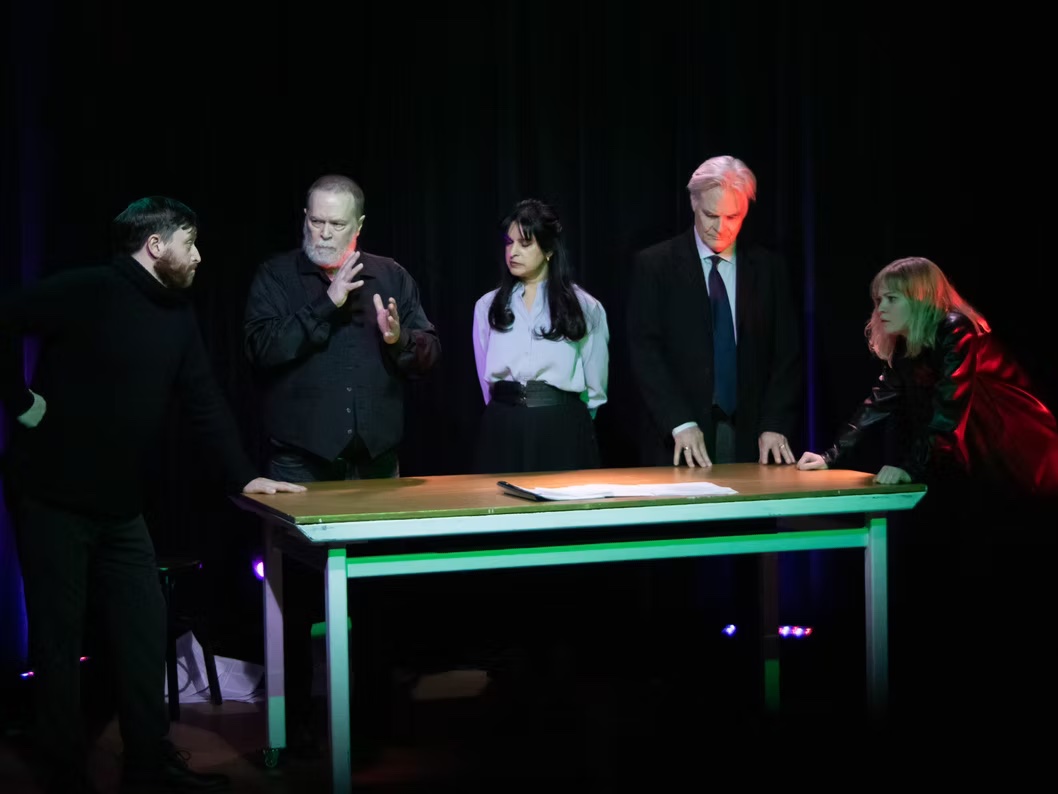
Sean Jacklin, Hume Baugh, Asha Vijayasigham, Gary Brennan, and Natalia Bushnik
Photo by Madison Pang
Camus’s text was a response to the rise of fascism which he witnessed as a young man living through the German occupation of France. We see this clearly embodied by the character of Cottard, who commits unspeakable acts throughout the play, and we do not see him repent for them. Yet the rest of the metaphor, of the rats who spread disease, of the hesitancy around calling the plague what it is, the learned people desperately trying to help but their pleas falling on closed ears, those have travelled from the realm of the absurd into our reality. And what’s more, I felt like neither Camus or Bartlett came to any kind of conclusion about the matter either. We obviously know that the fascists are seen as the enemy, that’s easily interpreted, but there’s never a moment where it feels like the hope has won out and things will be fine. There were a few moments where that happened, and I’d think “ah yes, what a great ending” and then the lights would come back up and the story would continue. While this repetitiveness is a hallmark of absurdist storytelling, it lacked the same kind of clarity as the ending of The Bald Soprano or Waiting for Godot.
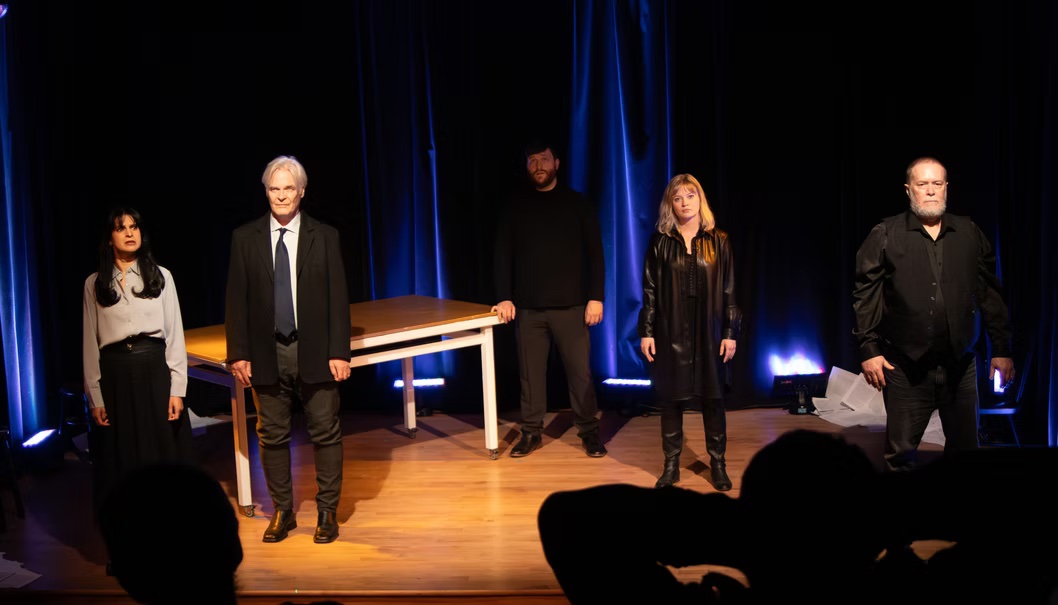
Photo by Madison Pang
You know how sometimes you get out of a meeting and you think “well, this could have been an email”? I came out of The Plague thinking “this could have been a podcast”. The world which co-directors Tom McHale and Alessandro Simari have created for this play is an almost entirely static one; there is hardly any movement throughout the play, and the table which they have chosen as their main (and essentially only) set piece takes up so much room on the stage that it doesn’t give the performers any room to move around. If this had been billed as a “live radio drama” like how It’s a Wonderful Life is often performed this time of year, I’d have totally understood the stagnant nature of the piece, but as it stands it feels underdeveloped.
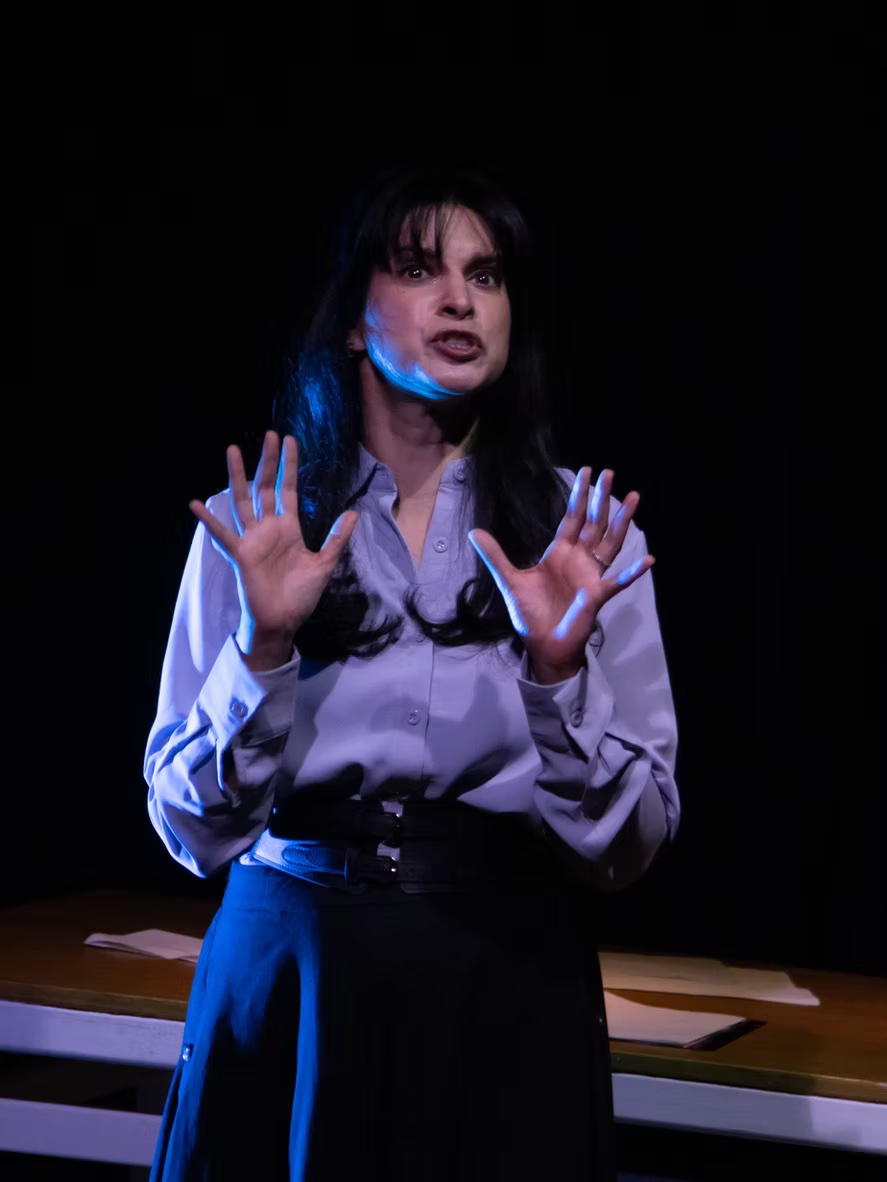
Asha Vijayasigham
Photo by Madison Pang
While it’s understood that there really isn’t a “backstage” to this space to speak of, it makes it rather awkward as the characters who aren’t involved in the scene are either staring blankly out into the audience or, and this was truly baffling, just staring at the wall like they were on a time out. Again, it’s understood that the Small World Centre is not a huge stage, but there could have been measures taken to either have those characters attentively listening to the others even when they weren’t involved, or to make better use of the apron of the stage to act as a holding space for those not directly in the scene. Unfortunately, the lighting design often left characters out of their light even when they were speaking, and the lights on the stage take up valuable stage space with little effect. While some elements of the sound design, like the sounds of the rats, were well timed, there were moments where the sounds actually were distracting from the dialogue being spoken.
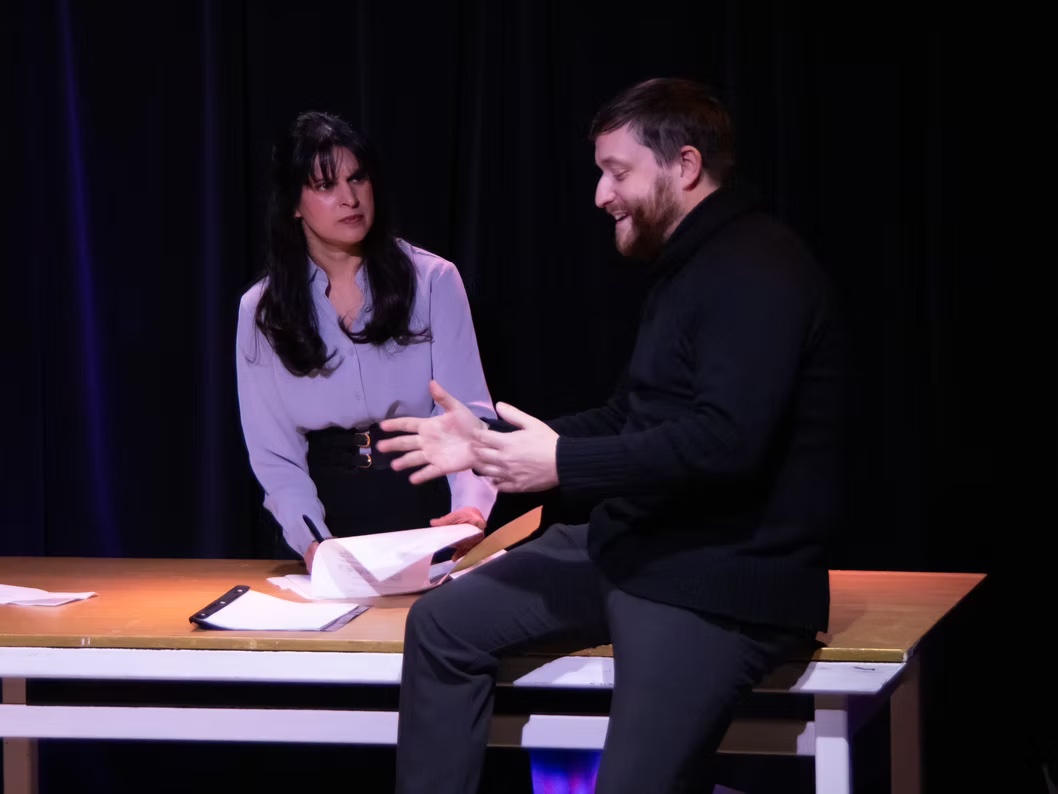
Asha Vijayasigham and Sean Jacklin
Photo by Madison Pang
There were some stand-out performances in The Plague, and Asha Vijayasingham’s Dr. Rieux is definitely one of them. Vijayasingham gives a passionate performance, carrying much of the text while also showing the depth of emotion in her character. Natalia Bushnik gives another emotionally charged turn as Tarrou, the socialite turned volunteer and friend to Dr. Rieux. Sean Jacklin’s Rambert likely has the most character development throughout the piece, and Jacklin deftly portrays those shifts.
I know that there will have to come a time where we are more ready to hear stories about our experiences with COVID-19 and widespread illness in general, but somehow this still feels all too familiar, and not in a comforting way. I think I might feel differently about The Plague if I felt like the story itself had a new or different light to shine on current events; but the danger of what’s occurring presently is keenly felt and recognized, particularly by anyone who’s going to be spending their time in a theatre. While this is a valiant effort by Outlier Theatre Collective, The Plague is not their best work to date, though I do look forward to seeing what they’ll produce next.
The Plague runs at the Small World Centre until November 29. For more information and tickets, visit: https://www.outlierstheatrecollective.ca/the-plague-2026
Cover Photo: Asha Vijayasigham, Sean Jacklin, Hume Baugh, Gary Brennan, and Natalia Bushnik. Photo by Madison Pang.
Thank you to my Patrons:
Natalia, Steve, Brendan, Deborah, and Phil
And to my supporters who’ve bought me a coffee:
Angelica and Paul, Anonymous, Adrianna, Caitlin, Jonathan, Jada, and Courtney
Would you like to become a Patron? Check out my Patreon at: https://www.patreon.com/AViewfromtheBox
Or, you can buy me a coffee at: buymeacoffee.com/aviewfromthebox

