You know that feeling: the one you get when you’re walking down a dark laneway late at night by yourself and you feel the hairs on the back of your neck stand up a little bit? When you start checking the shadows made by the streetlights in case there’s more than just your own? You turn down your music just a tad so that you still look like you’re occupied but you can still hear the noises around you? I am certain that many of you reading this right now are nodding your heads in agreement, because I still get this feeling on occasion walking home from the subway late at night, despite having lived here for six years. Liliana Padilla’s How to Defend Yourself, directed by Emily Anne Corcoran, might be about college students, but it captures the experiences and the dangers we feel long after we’ve left campus. Featuring a stellar cast and powerful narrative, How to Defend Yourself is a must-see show this month.
Susanna is Brandi’s “little” in their sorority, so when Susanna is brutally sexually assaulted at a frat party, Brandi knows she has to do something. She starts a self-defence class for anyone who wants to join on campus. Even some of the boys from the neighbouring fraternity show up to show their solidarity. As passions flare and secrets are revealed, we watch as these young people are forced to reckon with their pasts in order to feel more secure in the present. But will that safe feeling last, or is what happened to Susanna less of a rarity than they’d like to believe.

Photo by Elana Emer
I admire how much feminine rage Padilla was able to incorporate into How to Defend Yourself, and Corcoran and the team at Icarus definitely played on that with their pre-show music selection (many of the songs can be found on my own playlist, too). Rage and anger are emotions which most of us are not encouraged to feel, no matter our gender. Yet they’re a sign that something’s wrong: that a boundary has been crossed or that we see or feel injustice in our surroundings. Anger is something to be harnessed, as we witness in this play when the shy Nikki is able to give a hard and sure punch as soon as Brandi tells her to envision someone she’s angry with. Giving people the space to feel anger in a healthy way, particularly as they’re grappling with their sense of security at school, needs to proliferate more into the world, and seeing it through our art is a beneficial step.

Photo by Elana Emer
Initially, I was confused as to why with each passing day in the story another tile was removed from the foam flooring which covers the playing space. But in the penultimate moment of the play, I think I understood. When Nikki comes in after having been physically assaulted on her way to class, she blames Brandi and her lack of expertise for why she couldn’t defend herself from her attacker. This sends Brandi into a spiral, where even more of the floor tiles are being removed from under her feet – this is where it clicked for me. I think Brandi has also been assaulted, only in high school before she met any of the characters we meet in the play. So her getting her black belt, and the scolding thoughts like “if you practice hard enough it’ll become muscle memory and you won’t have to think” are immediately what comes to mind as that’s what she, along with many others, are told to do after such an event. This is heartbreaking, as we see the whole time that Brandi is trying desperately to turn the guilt she feels about Susanna into something positive through this class, and yet we literally watch it all crumble beneath her. Her trauma wasn’t properly handled, and she was made to feel responsible, to some degree, for what happened to her, a story we hear time and time again in the real world. How to Defend Yourself becomes a poignant reminder of the toll that approach takes, particularly on the victim, and how our mindsets and care practices need to change.
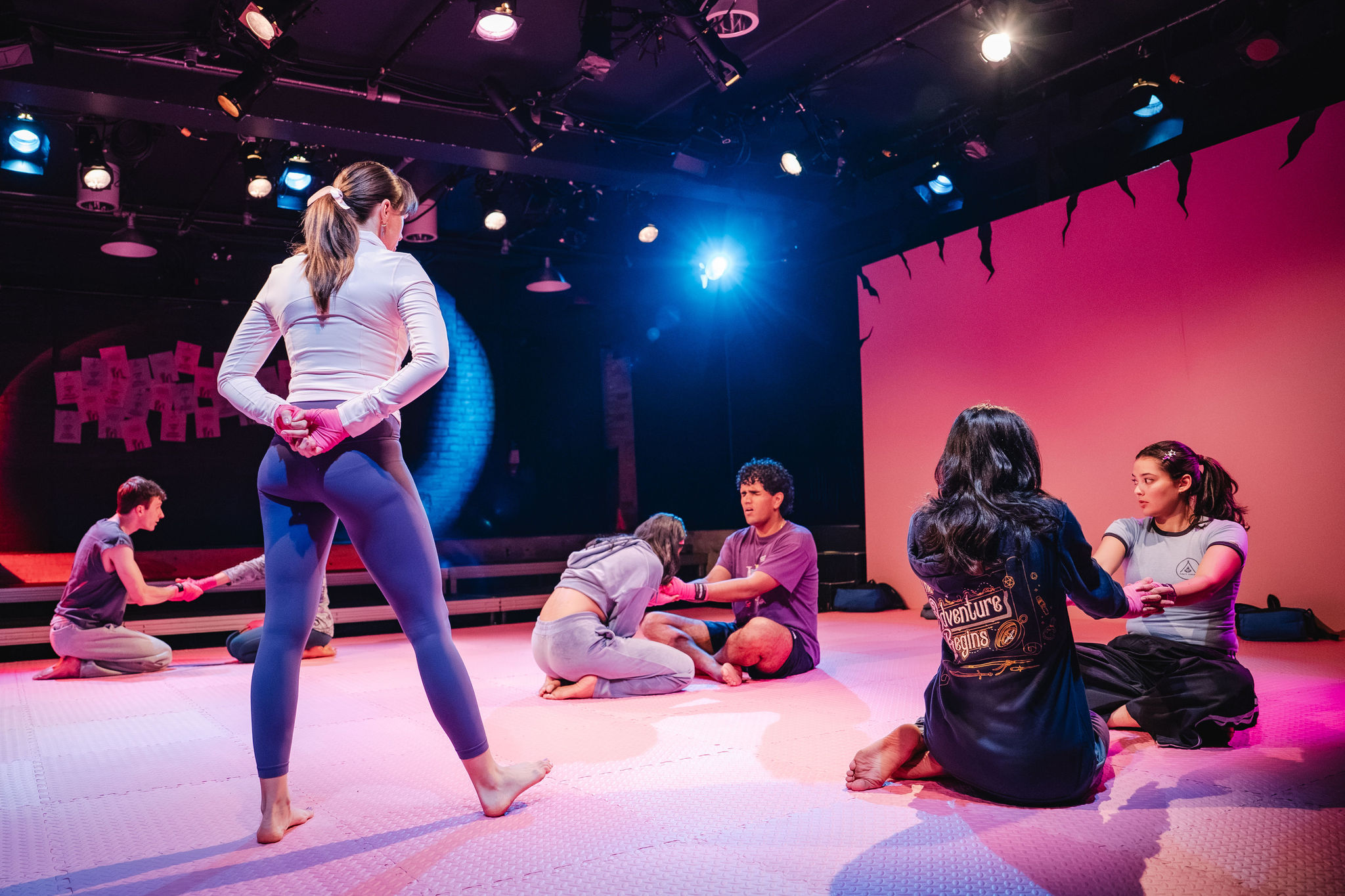
Photo by Elana Emer
My only qualm with this show, and this could very well be written into the text rather than a directorial decision, was that when they’re paired off in the class, they’re frequently talking over one another. While this certainly adds an element of realism to the scenes, it also makes me worried that I’m missing something important being said by one couple while I’m focusing on another one. Again, I fully concede that this could have been the desire of the playwright, but it does make for some difficult moments during the play.
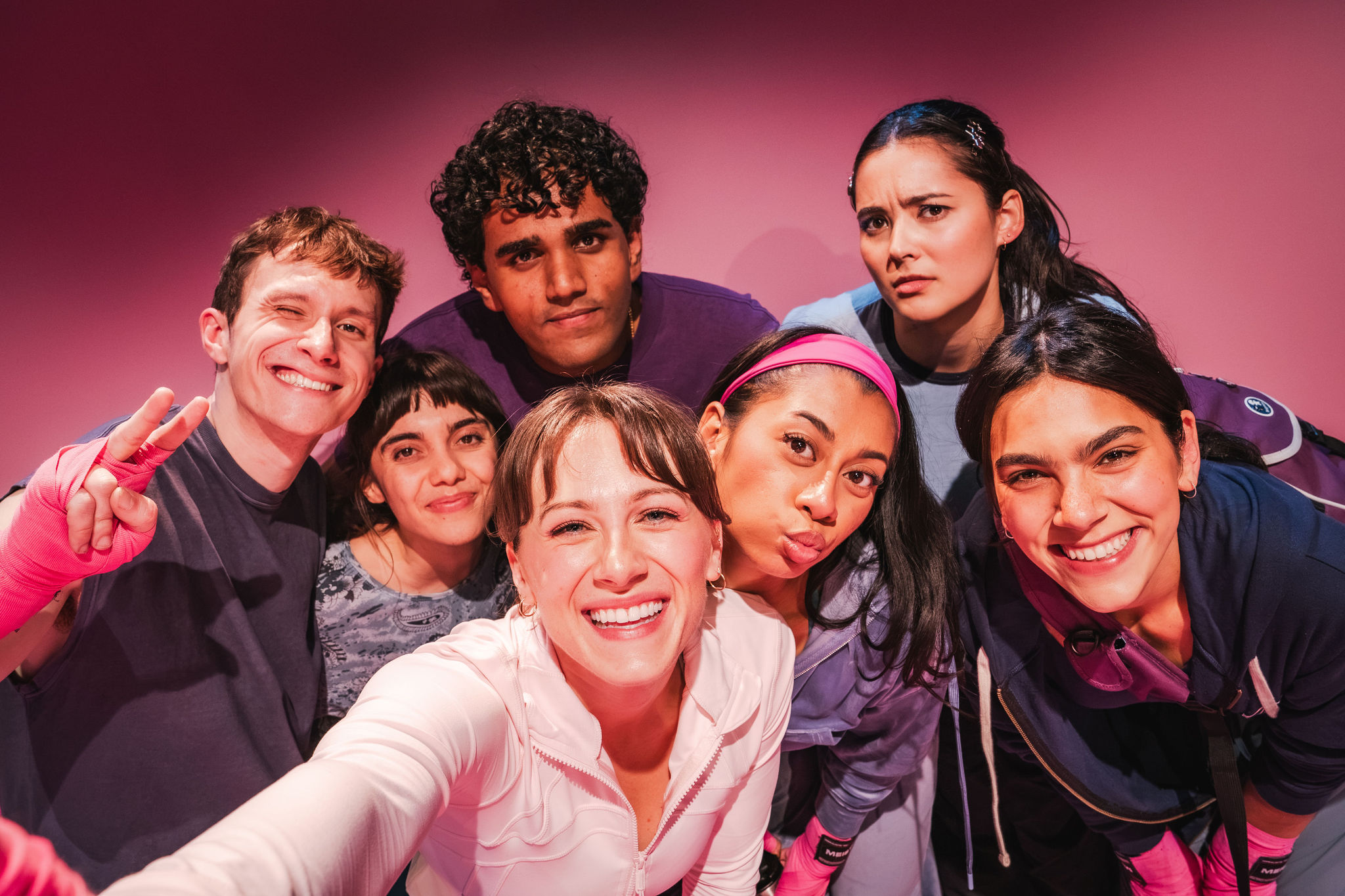
Photo by Elana Emer
How to Defend Yourself has a cast brimming with talent! Artistic director Anthony Goncharov plays Andy, alongside Samel Sunil’s Eggo as the two frat brothers who are trying to show their solidarity with the sorority girls. Goncharov’s charm and Sunil’s gentleness are perfect foils for each other. While I initially had my suspicions about their character’s involvement in the class, they both give very vulnerable speeches which make their intentions more clear and are great moments for both performers. Paula Goldie’s Diana is fierce, and Goldie gives her all in this role. Diana is also a very good opposite to her friend Mojdeh, played by Parastoo Amanzadeh, who is just dying to fit in with the sorority girls on campus. The two have great energy together and the way their characters change and diverge is fascinating to witness, yet feels familiar at the same time. Donnon Root’s Kara feels like your typical college girl, but Root gives her a depth which allows her to really shine. Kaeley Jade Wiebe’s Brandi almost feels like a Barbie at the beginning of the play: always smiling and saying the right things. But when Brandi’s world begins to shift, we get to see the heights of Weibe’s talent. The stand-out performance for me, however, is Sasha Kahn’s Nikki. Nikki begins the play as the quiet one, the one who clearly doesn’t fit with the group, yet we watch her confidence grow with each class. So when Kahn enters for her main monologue, out of breath and scared, it’s like time itself stops to listen in.
How to Defend Yourself is one of those plays where I hope that one day it won’t be as relevant as it feels now; that we’ll live in a society where we don’t have to walk down pathways with our keys between our fingers or travel around campuses in groups for fear of what happens if someone gets separated. There was also part of me which wondered how the men in the audience viewed the production: as a woman, I felt myself agreeing with these characters frequently and easily able to empathize with them despite having never been in their situation before. But in this way, How to Defend Yourself is for everyone – those of us who find validation in shared experiences and desires being portrayed on stage, and for those who could use a more intimate look at a different perspective.
How to Defend Yourself runs in the BMO Incubator at The Theatre Centre until November 28. For more information and tickets, visit: https://www.icarustheatre.ca/2627
Cover Photo: Donnon Root and Paula Goldie. Photo by Elana Emer.
Thank you to my Patrons:
Natalia, Steve, Brendan, Deborah, and Phil
And to my supporters who’ve bought me a coffee:
Angelica and Paul, Anonymous, Adrianna, Caitlin, Jonathan, Jada, and Courtney
Would you like to become a Patron? Check out my Patreon at: https://www.patreon.com/AViewfromtheBox
Or, you can buy me a coffee at: buymeacoffee.com/aviewfromthebox

