What would you do if the number of words you could say per day was limited to only 140? How would you choose to spend them, and on whom? And worse, what happens when the words run out? How to you discuss what to have for dinner or what to watch on TV? I can’t fathom that only having as many words as I’ve used for this opening paragraph could get me through an entire day. Sam Steiner’s dystopian rom-com Lemons, Lemons, Lemons, Lemons, Lemons puts these parameters to the test. Directed by Bonnie Duff, this haunting play looks at censorship, free speech, and communication through a unique lens. Performed by Jack Copland and Lara Lucia, Lemons, Lemons, Lemons, Lemons, Lemons asks us to look at how we connect with one another, and how our voices can help us persevere.
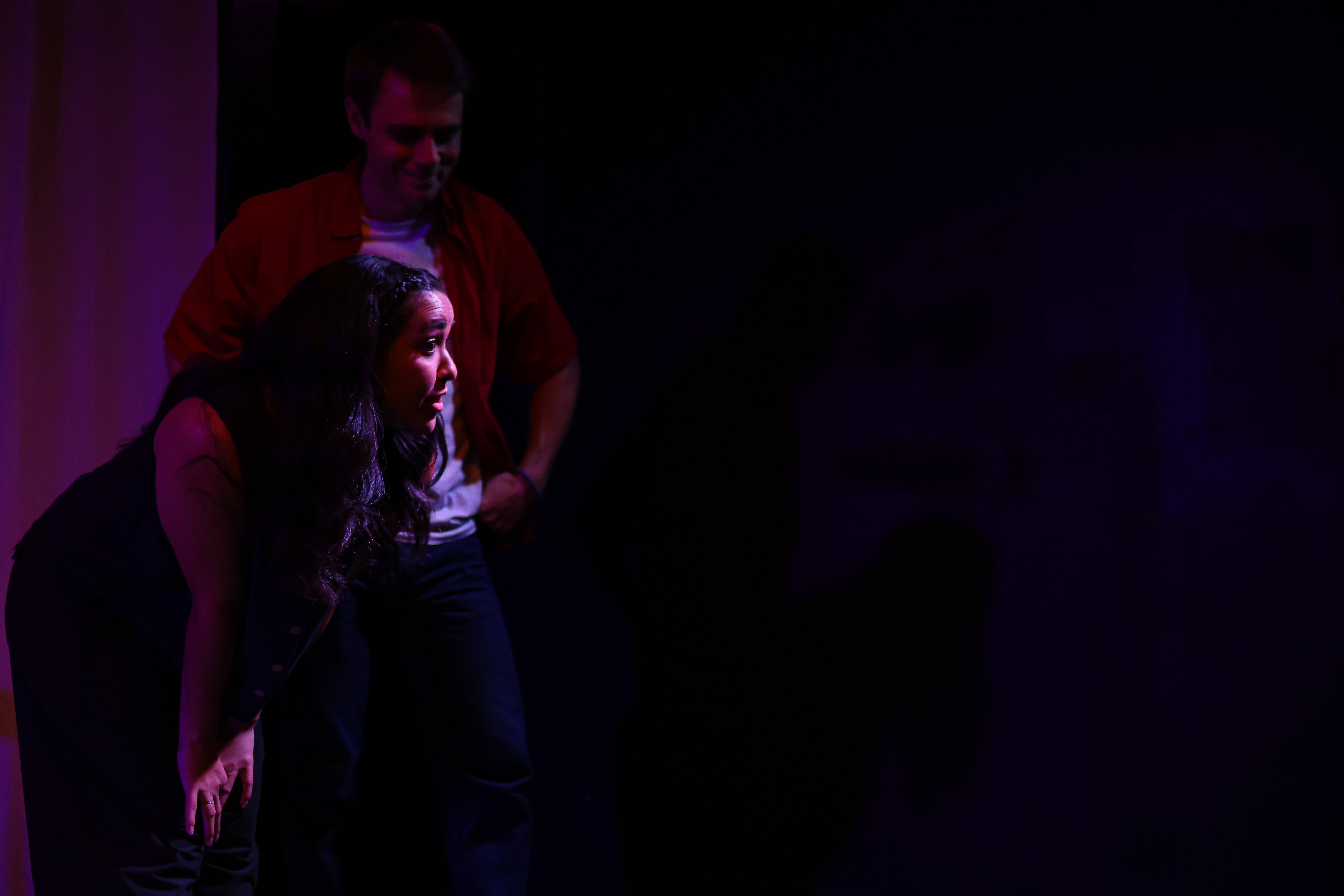
Photo by Barry McCluskey
Bernadette and Oliver meet at a pet cemetery, of all places. They hit it off right away: Bernadette is a family-lawyer in training, while Oliver is a musician and activist. Despite their different backgrounds, they make a lovely life together. But when the “Hush Law”, as it’s called by Oliver and his activist friends, comes into effect, the two of them must find a way to communicate using whatever remains of their allotted 140 words per day. As Bernadette’s values begin to conflict with Oliver’s advocacy, and they have fewer and fewer words to express themselves, their relationship begins to strain. Has this “Hush Law” hushed their relationship? Or can they find ways to express their love, and everything else, without words?
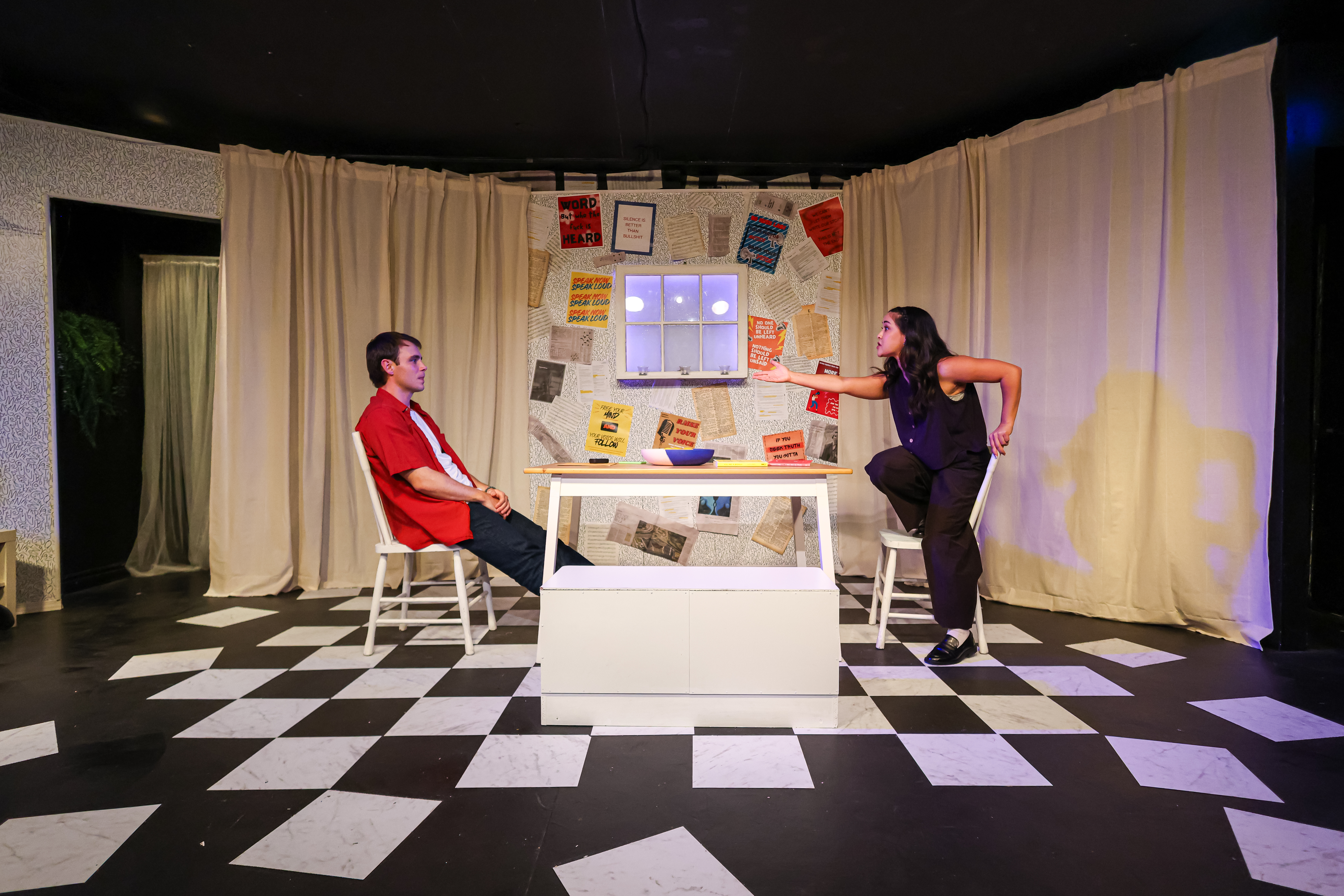
Photo by Barry McCluskey
Steiner’s text asks an interesting question: would limiting our word usage improve communication or destroy it? We all remember how inventive and fun Twitter used to be due to the 140 character restriction, a far more limiting rule than the “Hush Law”. Yet we witness a struggle for understanding both pre and post “Hush Law”. The non-linear storytelling used for Lemons, Lemons, Lemons, Lemons, Lemons allows the audience to have insight into both sides of their lives, one scene after the next. What’s more, is that it seems like Steiner doesn’t particularly have an answer either, which actually makes the text all the more profound. It proves the tenacity of the human spirit; how we can, and will, overcome whatever obstacles get put in our way. Even if that means silently standing up for what we believe in.
However, what Steiner’s text doesn’t give us is stakes: we have no clue if there are consequences for going over your word limit or not. How would they know? It is an honour system? Or is there some big-brother style system which consistently monitors them? It makes for a frustrating watch, as they sit there trying to silently communicate when there’s a pad of paper and pen right in front of them! Why do they not use it? Oliver is frequently seen with his phone out, why not text each other? These feel like such simple solutions to work around this repressive law, yet we’re never explicitly told why they can’t use these other modes of communication or what would happen if they do.
Photo by Barry McCluskey
Kenzia Dalie’s set design utilizes the full Assembly Theatre space, making the little window ledges into shelves and counters. My favourite element is the posters which cover the backdrop of the set. They showcase the general outcry against this “Hush Law” and give the audience an idea of the size of protest we’re looking at. Intermixed with these are what appear to be dictionary pages and other texts, a soon-to-be relic of times when words were used freely. Jay Hines’ lighting design is essential for showing us the shifts in time and location, as there are few other indicators on a single set. Yet I never felt lost or left behind as the lighting patterns clearly denoted where and when we were.
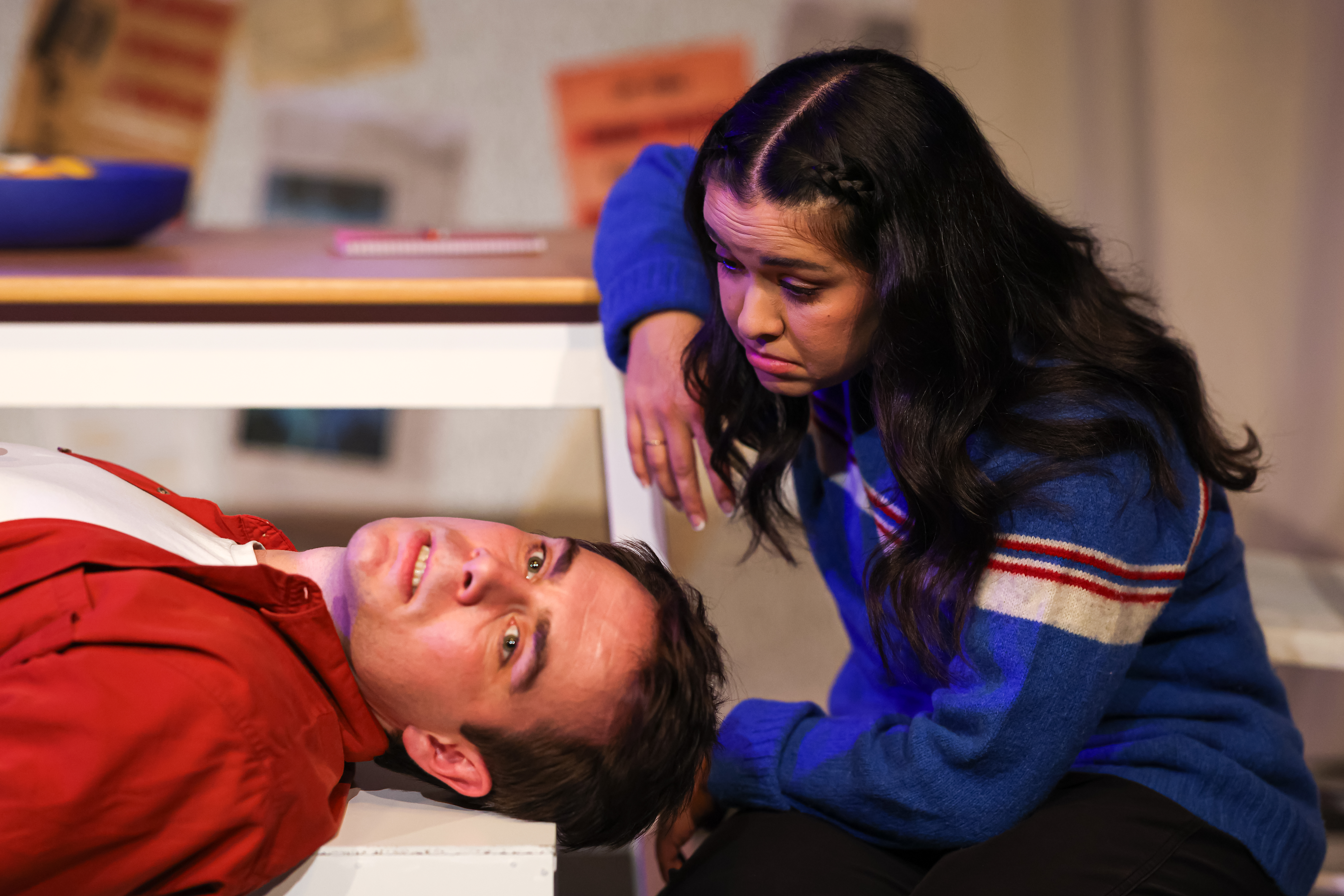
Photo by Barry McCluskey
Jack Copland and Lara Lucia are brilliant as Oliver and Bernadette. Their chemistry is palpable and I found myself rooting for Oliver and Bernadette’s relationship throughout the piece. Copland’s Oliver is earnest and leads with his heart, a perfect contrast to Lucia’s Bernadette who is very logical and methodical. They both have an irrepressible charm which shines even in the moments where their characters are furious with one another.
For every paragraph of this review, I’ve used 140 words or fewer; easy to do for a single paragraph, impossible to consider that in the world of the play it would be an entire day’s worth of words. Though Lemons, Lemons, Lemons, Lemons, Lemons falls more into the rom-com side of things than sci-fi, I think it uses the rom-com structure to ask a really important question: how can we communicate better with one another? Government imposed restrictions are clearly not the answer, but then what is? Lemons, Lemons, Lemons, Lemons, Lemons will certainly leave you thinking about that next phone call you make or text you send. Are you saying everything you want to? And what will you refuse to leave left unsaid?
Lemons, Lemons, Lemons, Lemons, Lemons runs at The Assembly Theatre until November 15. For more information and tickets, visit: https://theatreaurinko.ca/
Cover Photo: Jack Copland and Lara Lucia. Photo by Barry McCluskey.
Thank you to my Patrons:
Natalia, Steve, Brendan, Deborah, and Phil
And to my supporters who’ve bought me a coffee:
Angelica and Paul, Anonymous, Adrianna, Caitlin, Jonathan, Jada, and Courtney
Would you like to become a Patron? Check out my Patreon at: https://www.patreon.com/AViewfromtheBox
Or, you can buy me a coffee at: buymeacoffee.com/aviewfromthebox

