When you’re a teenager, the world feels huge and mysterious, and it’s hard to find anyone who will actually tell you what’s really going on. To find anything out, you have to rely on each other. Frank Wedekind’s remarkable play Spring Awakening, deftly adapted and directed by Paulo Santalucia, looks at a group of teenagers who are all on the brink: of adulthood, of desire, of death. Helmed by a cast of emerging talent and backed by legendary performers, Spring Awakening is the must-see show of the fall.
Though written well over a hundred years ago, Spring Awakening expertly encapsulates the tumult that is teenage-hood. Moritz and his best friend Melchior run to the woods after school to discuss their darkest secrets. Although anxiety ridden Moritz has a far more difficult time in the brave new world of pre-adulthood. The young ladies of the town also find relief in nature, though their discussions of future children and husbands have a significantly different tone to the boys’ philosophizing. When Wendla and Melchior meet in the woods, or in the hay loft, their newfound desires take over and change the course of their lives forever. Though at times bleak, there is still love abounding in Spring Awakening, and proof that there is still goodness to live for.
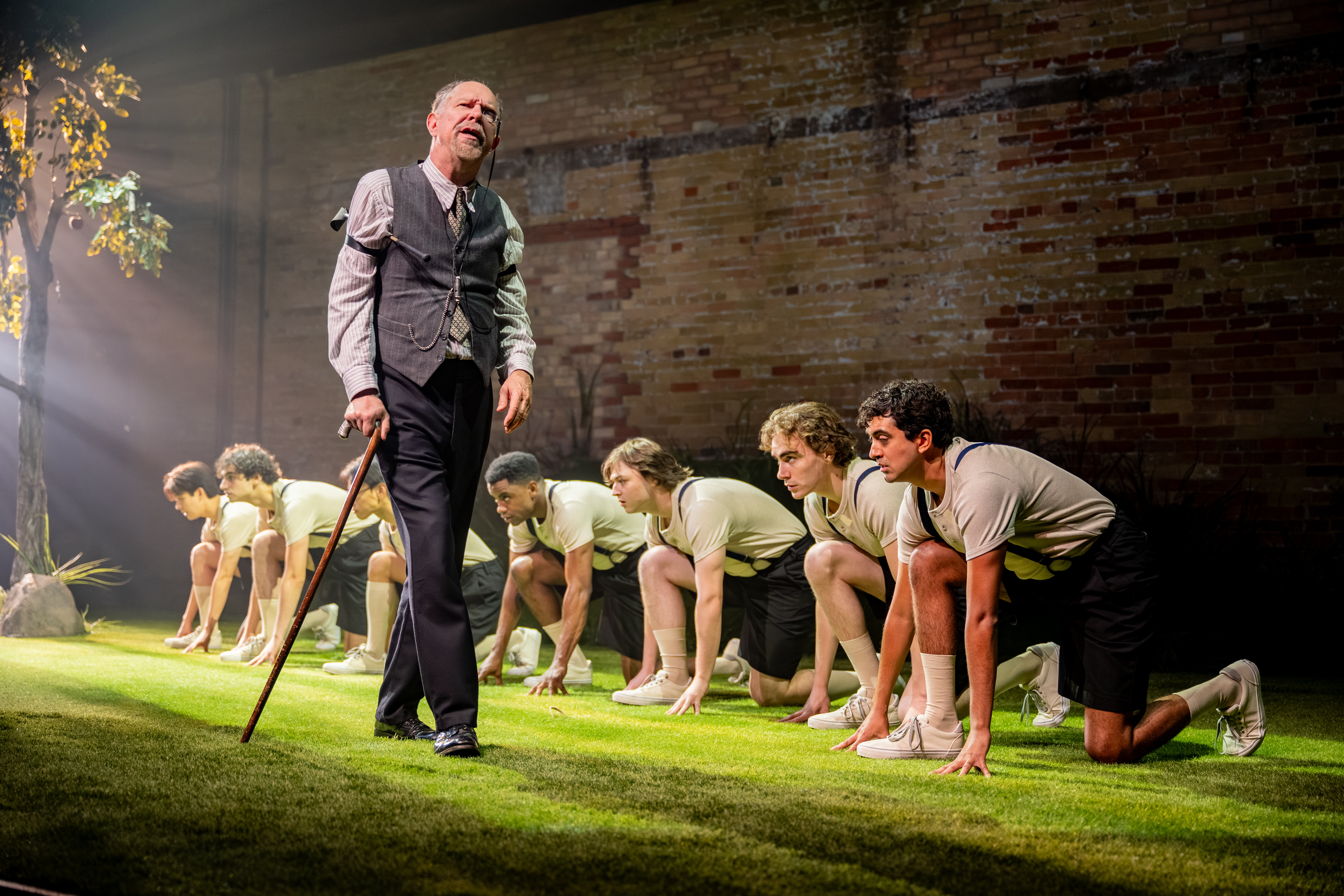
Photo by Dahlia Katz
Santalucia has done some brilliant adapting with this production. By putting the scenes where the boys are at school throughout the piece allows the audience to have a better idea of the stakes which are at play for these young men. A great deal about their lives depends on the success of their schooling, yet their teachers are strict and show little mercy, which takes its toll particularly on Moritz. These educational pressures of one’s teenage years are understandable and maybe even more universal in our own era, as anyone who has fretted about their grades being good enough can attest.
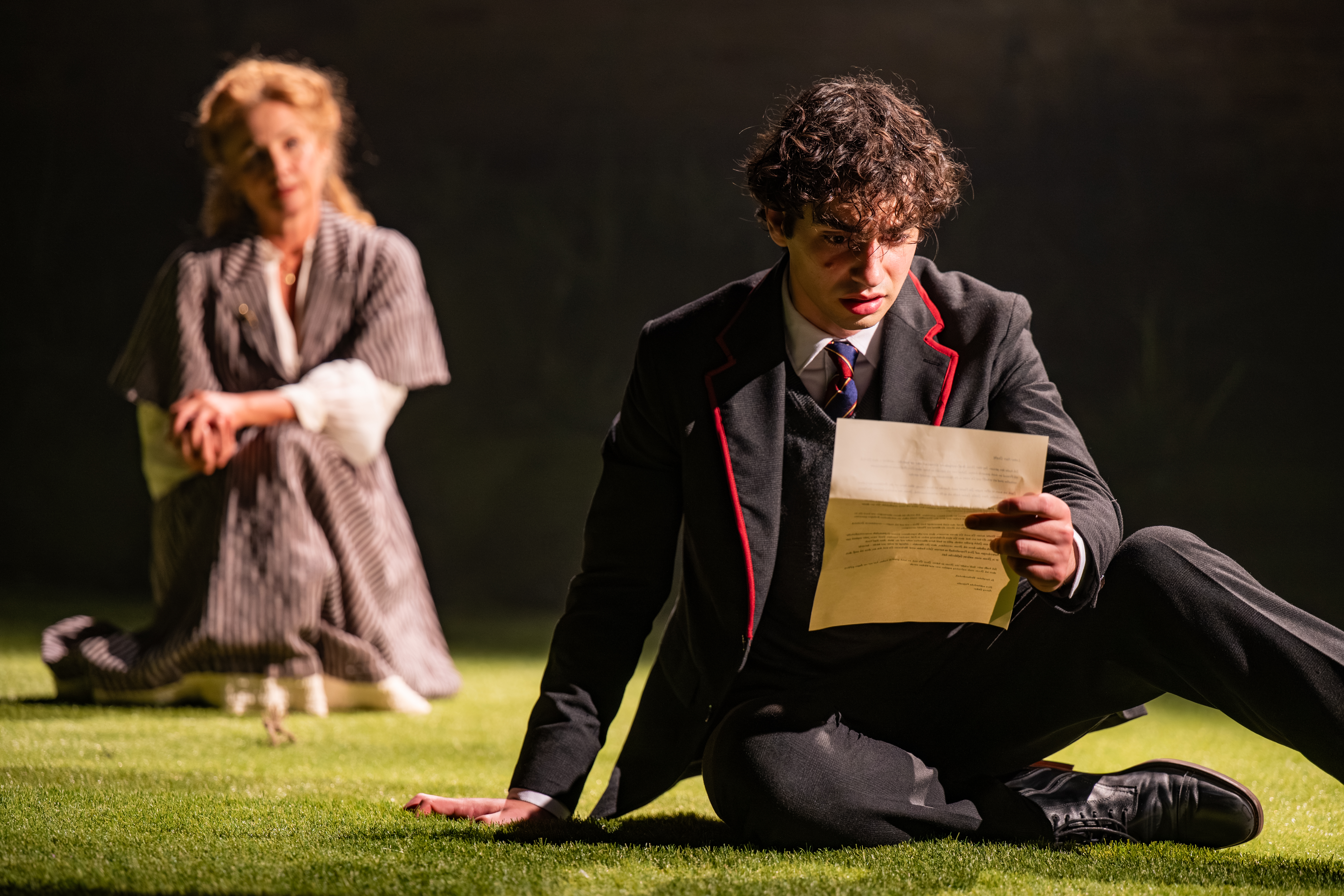
Photo by Dahlia Katz
The biggest juxtaposition in the play comes from the education (or lack thereof) we see the boys and girls receiving. The young men are learning Latin, geography, literature, and math – all the things which are supposedly supposed to give them a bright future. Yet they know little to nothing about their own bodies, how they’re changing, and where these new desires they feel are coming from. Wendla begs her mother to tell her about where babies come from, and has no other recourse but to accept her mother’s explanation that babies are born of love. Throughout the play, the audience must witness the repercussions of this lack of education, and the devastation it causes the community.
The contrasts in the play are highlighted by Shannon Lee Doyle’s impressive and versatile set design. The bleak, bare walls of their strict Catholic school stand in direct opposition to the beautiful nature which surrounds them. It’s there, on the grassy knolls and under the apple trees where the children in this story truly learn. Ming Wong 黄慧明’s costumes skillfully illustrate the rigid structure these characters exist in.
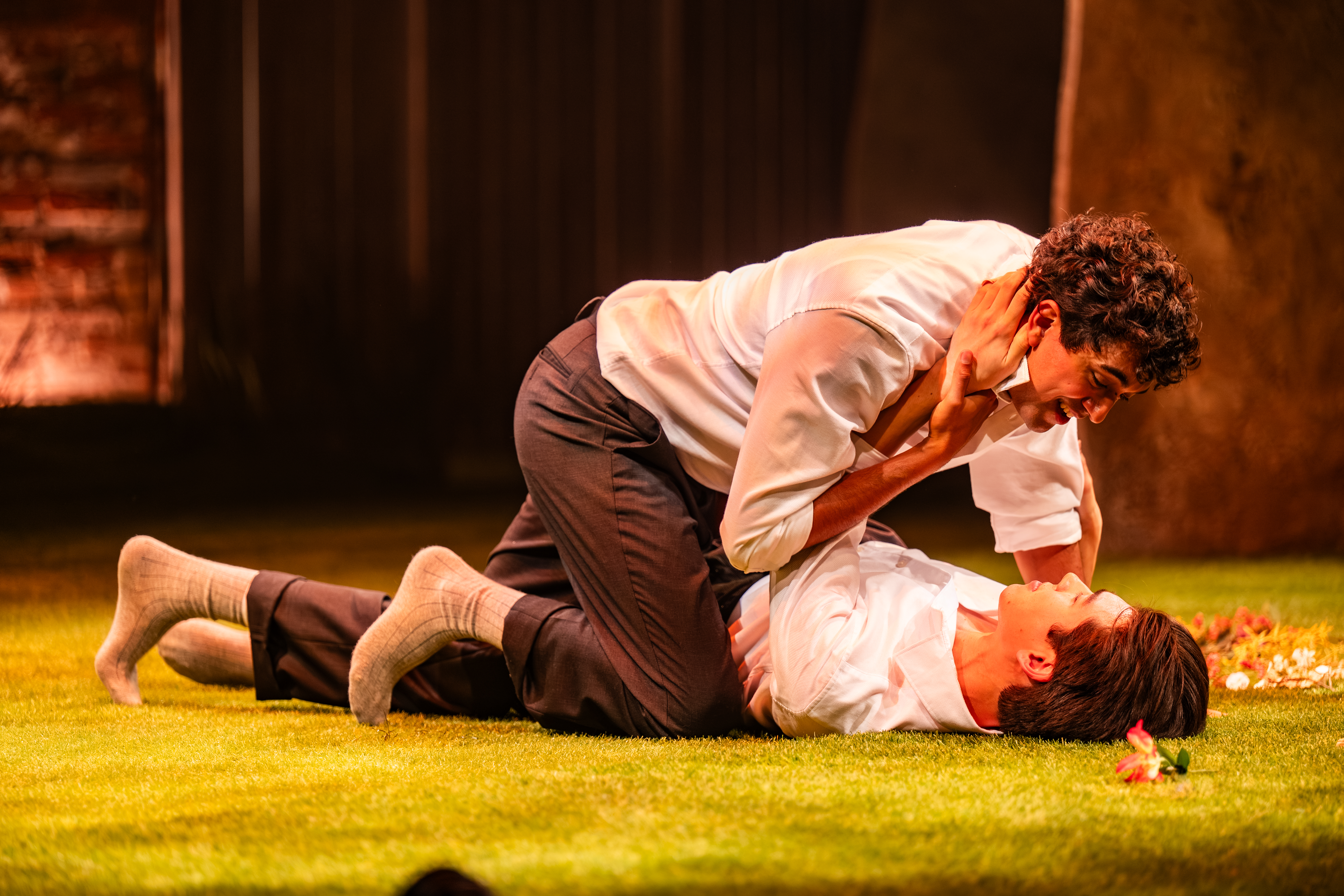
Photo by Dahlia Katz
As previously mentioned, many of the young cast members are relatively new to Toronto’s stages, and with such stellar performances I eagerly await seeing them in future productions. Jake Cohen’s Moritz broke my heart; he’s delightfully awkward at the beginning of the piece, but when Moritz’s anxiety turns to determination, Cohen makes that change abundantly clear. Jake Bunyan gives a depth and gentleness to Melchior which immediately makes me want to root for him. Bunyan gives him a quiet certainty which fits his forward ways of thinking. Olivia Neary-Hatton’s Wendla is curious and vivacious, and Neary-Hatton plays that exuberance excellently. Noah Beemer and Justin Eddy’s Hansy and Ernst show the true passions and desire of young love, particularly when that love is forbidden. Raylene Harewood and Jasmine Case’s Thea and Martha are perfect foils for Neary-Hatton’s Wendla; their lives are so vastly different to that of their friend, and I love how they weren’t too afraid to call her out on it, either. Mackenzie Wojcik, EJ Candelaria, and Eric Miracle round out the group of schoolboys. I love the little quirks their characters have and how much they shift between the sets of characters they play. Anaka Maharaj-Sandhu’s Ilse seems to straddle two worlds, both belonging to these youths and yet something of her own. Maharaj-Sandhu gives Ilse and understanding and gentleness which is exactly what a play like this needs.
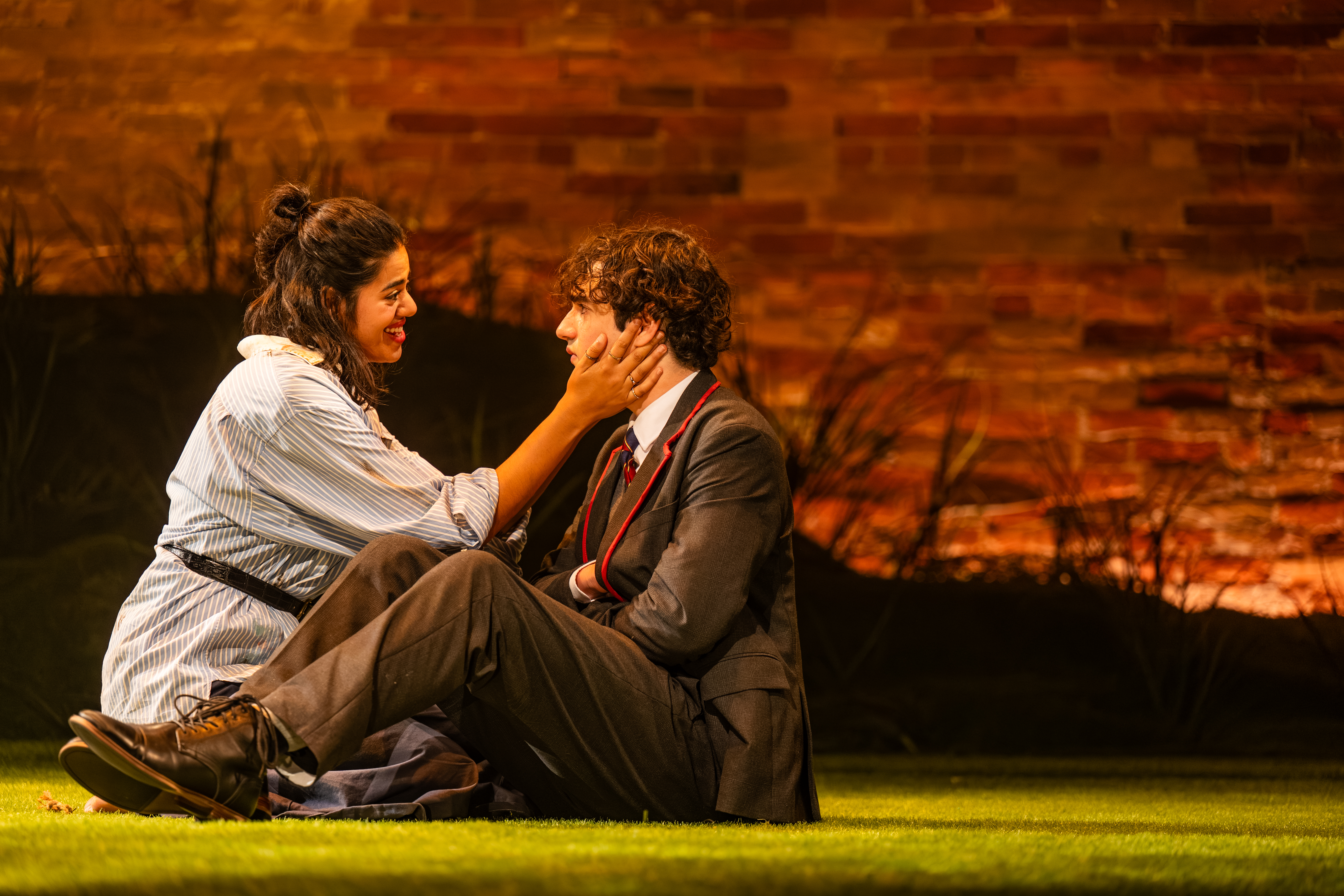
Photo by Dahlia Katz
Diego Matamoros is a strict and fearsome Professor Knockenbrüch, demonstrating how much pressure there is for these young men. Daren A. Herbert doffs his usual easy charm for intensity as Headmaster Hart-Brand. The interrogation of Melchior made me feel like I was on trial too somehow. Raquel Duffy’s Mrs. Gabor warmed my heart; another bright spot in an otherwise dark play, Duffy makes us all want to go to Mrs. Gabor’s for tea. However, it was Liisa Repo-Martell’s Mrs. Bergman who both frustrated me and broke my heart all at the same time. In her final scene, where Mrs. Bergman is finally having to explain to Wendla what’s actually happening with her body, Repo-Martell is so passionate, fiery, and devastating that I said “wow” under my breath as the lights went down.
I think what I learned the most from Spring Awakening is the danger of the taboo: deeming a topic to be too taboo to talk about only increases its power over us. For the teens in this play, it’s sex and desire and the new flood of emotions they’re feeling which no one has taught them to deal with. Nowadays it’s things like knowing how much money someone makes which is again being used as a tool to make it so that we don’t know when we’re being underpaid by our employers. If something is being deemed as taboo in our society, it’s up to us to challenge that, to ask why, and figure out how the system is trying to use it to keep us down before it’s too late. It was too late for most of the young people in this play, but Wedekind is giving us the push to ensure that future generations don’t have such a childhood.
Spring Awakening has been extended through to October 18, with two extra performances recently added to the run! For more information and tickets, visit: https://soulpepper.ca/whats-on/spring-awakening/
Cover Photo: Olivia Neary-Hatton and Jake Bunyan. Photo by Dahlia Katz.
Thank you to my Patrons:
Natalia, Steve, Brendan, Deborah, and Phil
And to my supporters who’ve bought me a coffee:
Angelica and Paul, Anonymous, Adrianna, Caitlin, Jonathan, Jada, and Courtney
Would you like to become a Patron? Check out my Patreon at: https://www.patreon.com/AViewfromtheBox
Or, you can buy me a coffee at: buymeacoffee.com/aviewfromthebox

