Where you do find inspiration? In nature? Other art? Or maybe even in another person? When the muse calls, no matter where you find it, you always feel compelled to answer, even if answering it might take over your life. Christina Anderson’s How to Catch Creation, directed by Mumbi Tindyebwa Otu, examines the lives of several artists across generations and how their lives eventually intertwine, for better or for worse. Though it’s profundity feels a bit contrived, How to Catch Creation is less of a call to action than it is a warning of the sacrifices creative people are forced make in today’s society.
How to Catch Creation features six characters who we meet in pairs, but whose lives mingle and tangle with one another. The first pairing is Stokes and Riley, played by Danté Prince and Germaine Konji. Stokes is a painter who is trying desperately to get into art school, while Riley works in tech and has a Master’s Degree in Computer Science. Riley supports Stokes and his dreams, but when Stokes suddenly changes trajectories after becoming engrossed by the works of author G.K Marche, Riley feels lost and is unsure of how to continue to encourage him and his art. But when a major life event happens unexpectedly, will the couple thrive or collapse under the pressure? Prince is charming as Stokes, and makes you fall in love with the character easily. Konji’s Riley feels a little one-note, but in the moments where Riley’s happy Konji does get to shine.
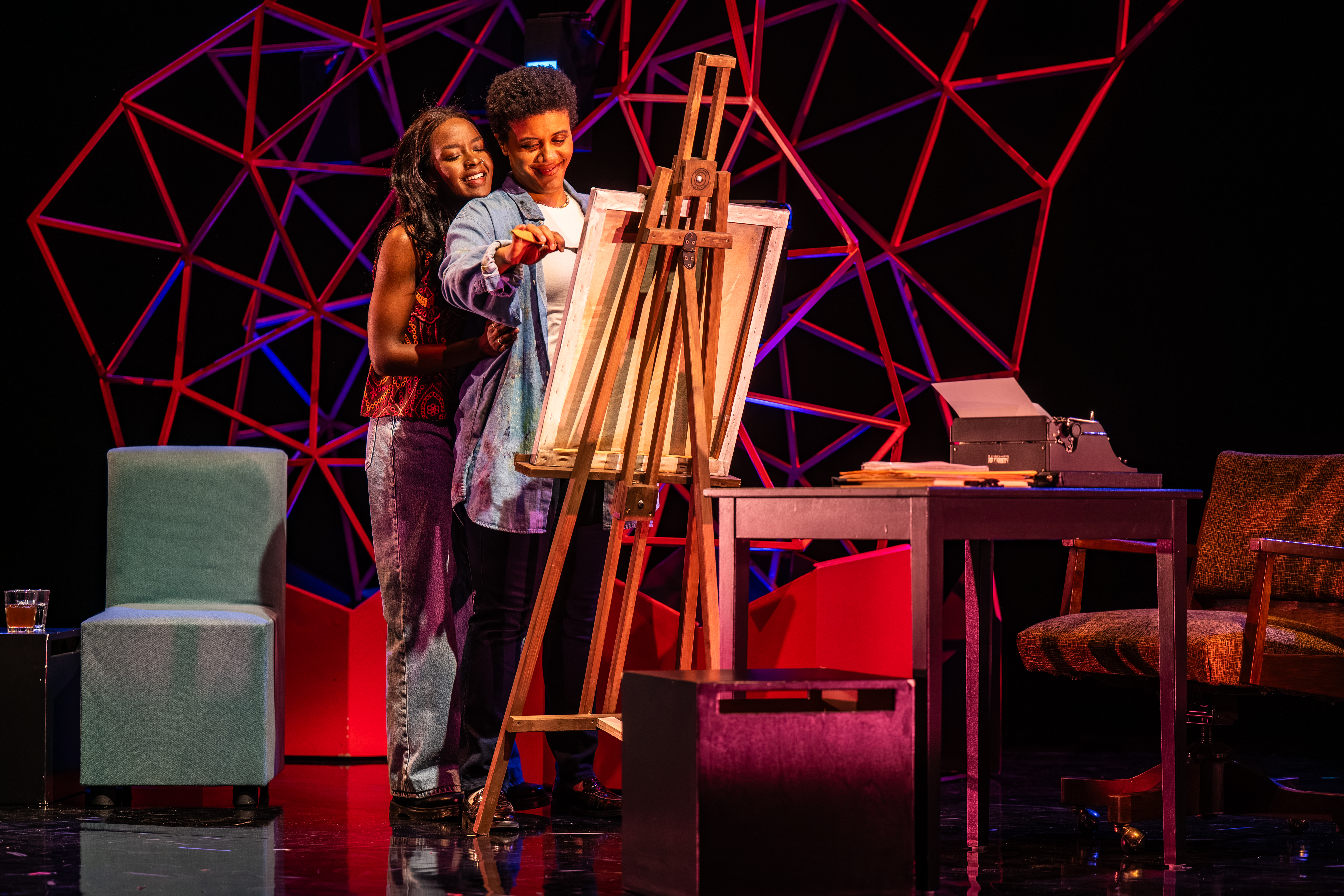
Pictured (L to R): Germaine Konji, Amanda Cordner in HOW TO CATCH CREATION by Christina Anderson, Directed by Mumbi Tindyebwa Otu, (2026). Set Design by Teresa Przybylski, Costume Design by Ming Wong, Lighting Design by Andre Du Toit, Sound Design by Heidi Chan. Photo by Dahlia Katz.
Amanda Cordner and Daren A. Herbert play Tami and Griffin, two good friends who have known each other for over twenty years. Tami is the program director for the art school Stokes has applied to. Griffin is a formerly-incarcerated man who was wrongfully convicted for serious crimes. He now spends his time giving talks about the legal system and its effects on those within it. Griffin meets Stokes one day at the park, and the two hit it off right away, primarily over their love of G.K Marche. Tami and Riley meet when Riley comes to ask Tami for feedback on Stokes’ work, however the two of them become enmeshed on a deeper level almost immediately. Tami and Griffin both have secrets they’re keeping from each other, and when those secrets come to light, their decades-long friendship is put to the ultimate test. The scenes where Cordner and Herbert are hanging out together are over the top with their energy and feel like they’re incongruous with the rest of the play. Tami and Griffin act totally different when they’re together than they do with others; while I understand that we all have public and private selves, the difference is quite stark. They’re also always drinking when they’re together. I don’t think I’ve ever seen so much fake wine on stage before! It just seemed odd that the two of them are never together without a drink in their hands.

Pictured (L to R): Daren A. Herbert, Amanda Cordner in HOW TO CATCH CREATION by Christina Anderson, Directed by Mumbi Tindyebwa Otu, (2026). Set Design by Teresa Przybylski, Costume Design by Ming Wong, Lighting Design by Andre Du Toit, Sound Design by Heidi Chan. Photo by Dahlia Katz.
The last couple are G.K Marche herself and her partner Natalie. This part of the play takes place in 1966, when G.K is at the height of her writing career and the words are truly flowing for her. Natalie is becoming a well-known seamstress and fashion designer, which means that the two of them rarely see each other. When infidelity comes between them, will it make the couple stronger, or will they implode? Shakura Dickson’s Natalie is determined and strong, a perfect role for this performer. Khadijah Roberts-Abdullah gives an outstanding performance as G.K Marche; she plays her as both a young and older woman and she embodies her with grace and care. Their story line certainly grabs me more than the modern plot; there’s so much more at stake for two queer women in the 60’s, when it was still illegal to be gay in the US.
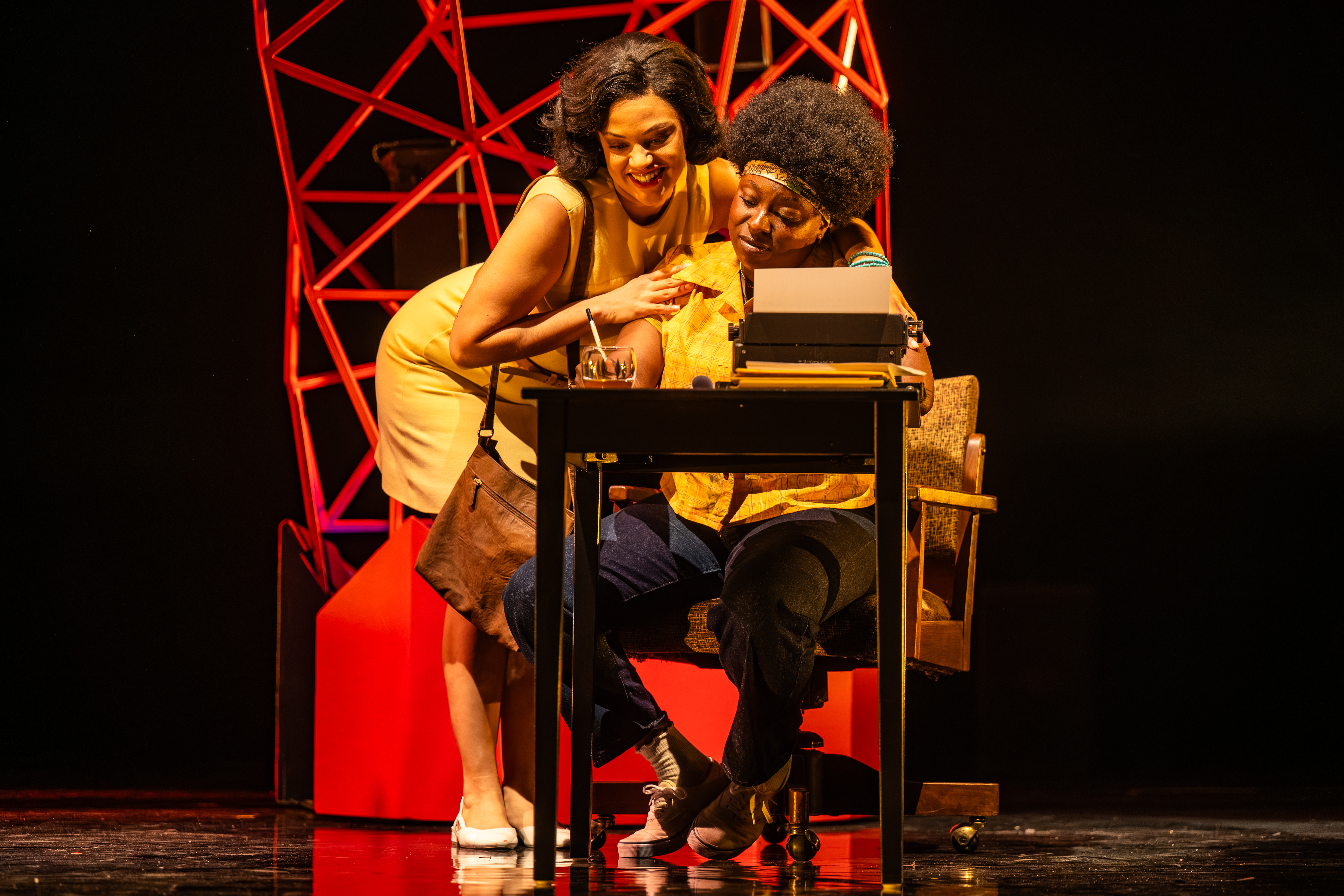
Pictured (L to R): Shakura Dickson, Khadijah Roberts-Abdullah in HOW TO CATCH CREATION by Christina Anderson, Directed by Mumbi Tindyebwa Otu, (2026). Set Design by Teresa Przybylski, Costume Design by Ming Wong, Lighting Design by Andre Du Toit, Sound Design by Heidi Chan. Photo by Dahlia Katz.
Teresa Przybylski’s set design is an interesting choice: there’s a large, round, lighting fixture covered in LED tube lights which dominates the upper part of the space, while two red, angular sculptures sit beneath that. Paired with some modular furniture to become any locale, it’s mostly left to the imaginations of the audience, and cues from the text itself, as to where we are. Though the light feature and sculptures are cool to look at, I didn’t feel like they were adding to the story in any way.

Pictured (L to R): Danté Prince, Daren A. Herbert in HOW TO CATCH CREATION by Christina Anderson, Directed by Mumbi Tindyebwa Otu, (2026). Set Design by Teresa Przybylski, Costume Design by Ming Wong, Lighting Design by Andre Du Toit, Sound Design by Heidi Chan. Photo by Dahlia Katz.
Anderson’s text does a good job of weaving together the stories, doling us out the right amount of information to keep us interested for the two hour run-time. Yet the text as a whole felt forced. I think they used the word “create” or “creation” multiple times within the first five minutes of the play. This kind of heavy-handed messaging made me feel like the author thought I wouldn’t be able to get the point of their play without referencing the title. I also felt like the ending was far too tidy for how messy the second act of the play gets. As soon as Act II started, I felt like I knew how the play was going to end, and it did not end that way. To me, there was a possible ending where everyone was going to be actually happy and able to continue to live the creative lives they had found with one another, and yet that’s not the ending Anderson gives them. Instead, they all are making sacrifices of some sort to get to a semblance of happiness which isn’t guaranteed to last. While it is refreshing to see people stepping up rather than running away when things get tough, we’re not invited into their psyche to understand why they’ve made that choice. We never hear the tough conversations between the characters, or at least not in a way where they weren’t shouting over one another, so we don’t get a sense that this is what these characters actually want.
How to Catch Creation is a jumble of mixed messages which left me puzzled rather than inspired. Riley, Stokes, and Tami all abandon their more creative selves for what one can assume they thought they had to do, but why? How to Catch Creation certainly left me thinking, and I’m sure I’ll be mulling it over for a long time coming.
How to Catch Creation runs in the Baillie Theatre at the Young Centre for the Performing Arts until May 17. For more information and tickets, visit: https://www.soulpepper.ca/performances/howtocatchcreation
Cover Photo: Pictured (L to R): Daren A. Herbert, Amanda Cordner in HOW TO CATCH CREATION by Christina Anderson, Directed by Mumbi Tindyebwa Otu, (2026). Set Design by Teresa Przybylski, Costume Design by Ming Wong, Lighting Design by Andre Du Toit, Sound Design by Heidi Chan. Photo by Dahlia Katz.
Thank you to my Patrons:
Natalia, Steve, Brendan, Deborah, and Phil
And to my supporters who’ve bought me a coffee:
Angelica and Paul, Anonymous, Adrianna, Caitlin, Jonathan, Jada, and Courtney
Would you like to become a Patron? Check out my Patreon at: https://www.patreon.com/AViewfromtheBox
Or, you can buy me a coffee at: buymeacoffee.com/aviewfromthebox

