“Let’s go.
We can’t.
Why not?
We’re waiting for Godot.
Ah!”
Didi and Gogo’s refrain echoes throughout Waiting for Godot, their seemingly endless plight summed up in a quick exchange. Samuel Beckett’s eternal story of humanity’s struggles feels more poignant than ever. This production, expertly directed by Kelli Fox, hits all the right beats while also making this absurdist classic feel new and refreshed. Featuring a seasoned cast and highlighting the humour in this darkly funny script, Waiting for Godot reminded me of why I love this play as much as I do.
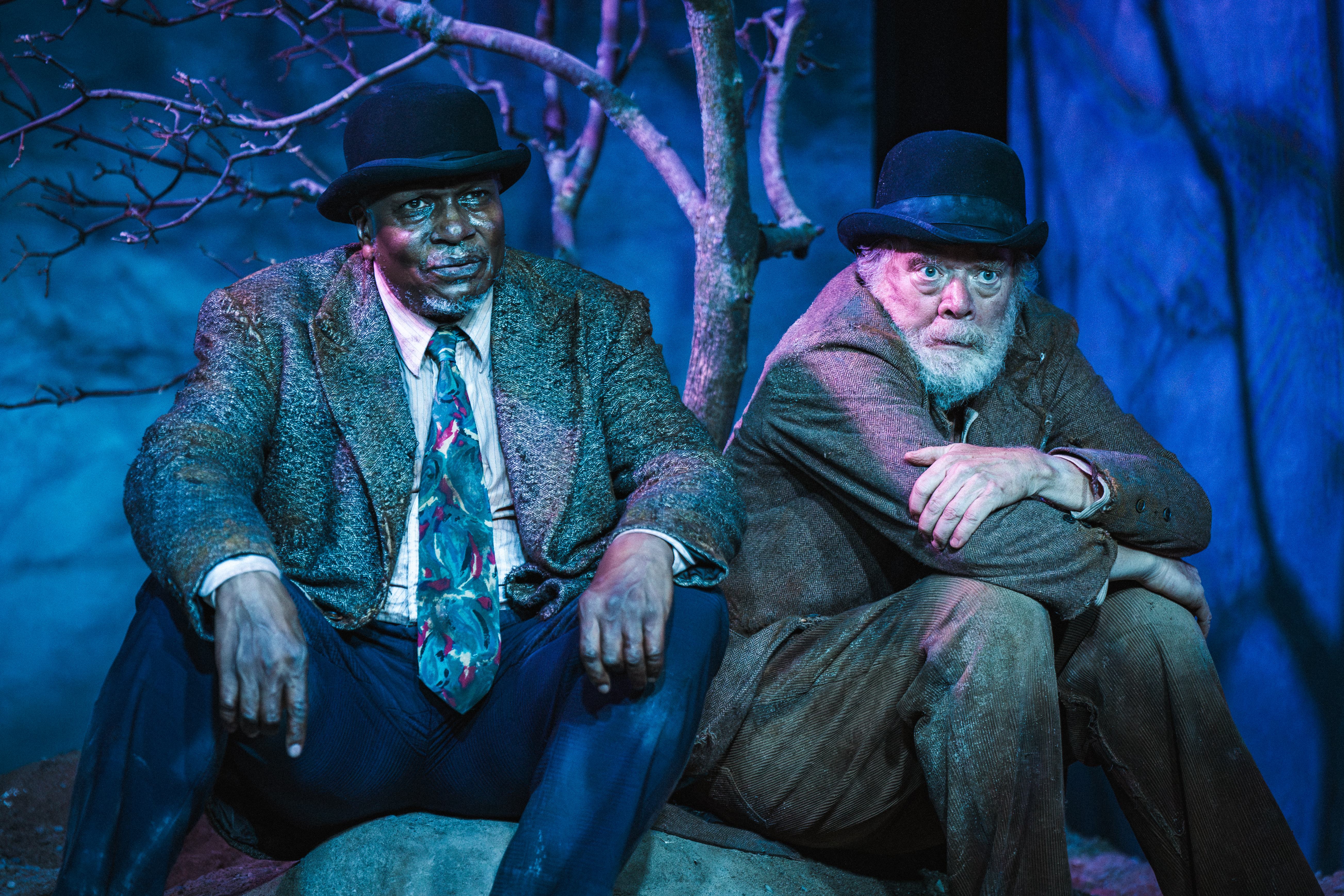
Photo by Elana Emer Photography
Though it feels like Waiting for Godot has certainly permeated throughout a great deal of popular culture, a little recap of what happens, or rather doesn’t happen, should be in order. Vladimir (Didi) and Estragon (Gogo) have met one evening under a lonely tree in the middle of a desolate area alongside a road. Vladimir has told Estragon that they’re waiting there to meet Godot, and Mr. Godot is sure to come, as promised. So they wait, and while they wait they talk about all kinds of things, from their suffering as poor men, to the state of humanity, to having little tiffs only to make up again. As boredom creeps in faster than the night is falling, suddenly they are joined by two more men: Pazzo, the master, and Lucky, his carrier. Pazzo is a grand man and is ensures that those around him know it, while Lucky seldom utters a word unless he’s bade to. Eventually, Pazzo and Lucky depart, leaving Didi and Gogo to themselves and their imaginations again. However, when a young boy approaches, they believe Godot will be accompanying him, only to discover from the lad that Godot is not coming, but will come again tomorrow. The next day, or so Vladimir assumes it is, runs much like the first, only something’s off: Gogo is acting differently and doesn’t fully recall the previous day’s meeting, Pazzo and Lucky are total strangers compared to their first entrance, and Didi seems to have a newfound eloquence. When the young boy comes again, Vladimir and Estragon’s future feels more uncertain than ever.
“Nothing happens, nobody comes, nobody goes, it’s awful!”
Gogo’s observation hits a little close to home in terms of Godot’s structure: only Pazzo, Lucky, and the Boy are free to come and go, Didi and Gogo never really leave the stage (except for when Didi needs to relieve himself). Beckett has allowed these meta moments of Didi and Gogo criticizing Pazzo and Lucky’s performances to slip in, allowing the audience to likewise critically think about the play they too are watching. However, what strikes me the most about Beckett’s text is the pacing: when the two are in quick bouts of back and forth dialogue versus slower, more thought out moments. The juxtaposition of the speed of their speeches mirrors the time dilation they’re experiencing as they wait for Godot’s appearance. It’s part of what makes Waiting for Godot such a timeless piece and one which can be explored time and again: it’s easy to view it multiple times and find new or exciting things awaiting you within the choices the director and performers make with the text.

Photo by Elana Emer Photography
Hands down, my favourite moment in the play is when Lucky is asked to think, and Simon Bracken’s performance did not let me down. There is something about this wild, uninterruptible stream of consciousness which seems profound but truly says nothing which I absolutely love. Add to it that Fox has them do a Scooby-Doo like chase scene as they try to take off Lucky’s hat, all while he’s still prattling on about this or that, and I was in stitches! It is certainly something which I thought this production did excellently: the funny parts were truly very funny, and that humour is able to carry us through the more dark moments of the play.
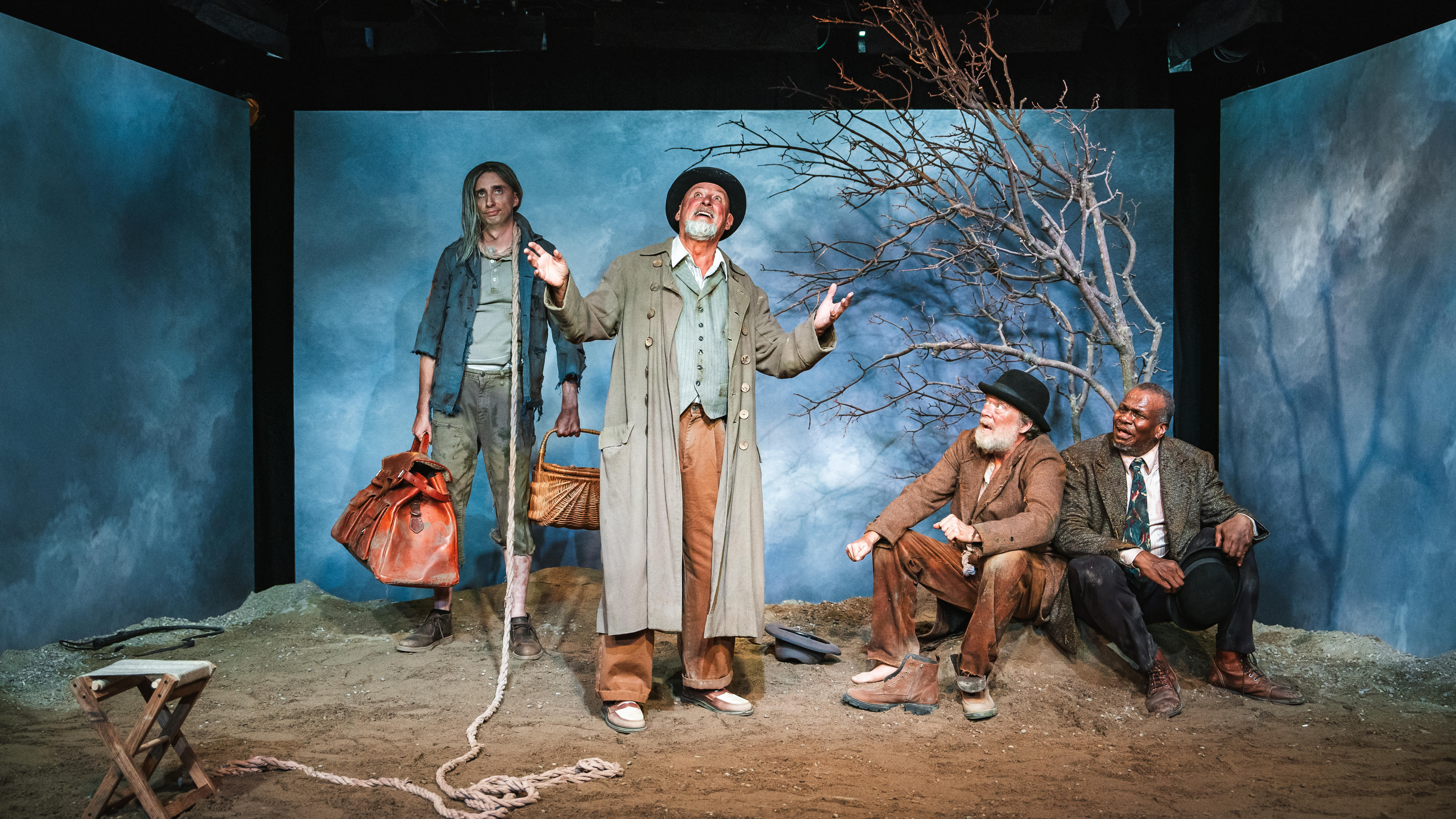
Photo by Elana Emer Photography
Ted Dykstra and Alexander Thomas play the iconic Estragon and Vladimir. Dykstra perpetually has a frazzled and somewhat mischievous nature as Gogo. While Thomas’ Didi is clearly the brains of the operation, and he brings a calm and directness to the character. The two of them work beautifully together; they have great chemistry and there’s a genuine care and closeness you feel from them. Jim Mezon’s Pazzo is perfectly larger than life, making both of his entrances grand and unmissable. Bracken’s Lucky has amazing physicality and presence on stage, though most of the time he’s quiet and still. Kole Parks does a fantastic job as Boy. He likewise has impressive stage presence for one so young, and holds his own against the titans of theatre he shares the stage with.

Photo by Elana Emer Photography
All of this occurs on Scott Penner’s stunning set design. The walls are painted to look like a cloudy sky, making the barren tree somehow look even more sad. The real dirt and gravel on the floor not only solidifies the outdoor nature of the show, but also gives the movement that extra sound element and makes it feel very tangible and gritty. Louise Guinand’s lighting design really pops, showing us the excruciatingly slow, and then very sudden, passing of time. Combined with Ming Wong’s perfectly executed costume design, this is a quintessential production of Waiting for Godot.
I suppose the real question now is: what do we do? Do we keep waiting for our potential reward, or do we make our own ending? While Waiting for Godot often looks like a tragedy, there’s some hope in the fact that Gogo leaves his boots at the spot, and we know they’re going to come back tomorrow. As long as we keep moving forward, and as long as we keep coming back to one another, is that not our true purpose? I think Waiting for Godot lets us find the answers to that question, and many more, within the depths of its fantastic story, where nothing really happens.
“Well? Shall we go?
Yes, let’s go.
[They do not move.]”
Waiting for Godot runs at Coal Mine Theatre until October 12. For more information and tickets, visit: https://www.coalminetheatre.com/waiting-for-godot
Cover Photo: Ted Dykstra and Alexander Thomas in Waiting for Godot. Photo by Elana Emer Photography.
Thank you to my Patrons:
N. Bushnik, S. Fisher, B. Kinnon, D. Moyes, E. O’Brien
And to my supporters who’ve bought me a coffee:
Angelica and Paul, Anonymous, Adrianna, Caitlin, Jonathan, Jada, and Courtney
Would you like to become a Patron? Check out my Patreon at: https://www.patreon.com/AViewfromtheBox
Or, you can buy me a coffee at: buymeacoffee.com/aviewfromthebox
 A View from the Box