Imagine walking down Dundas Street and only ever seeing the faces of other men; there’s not a woman in sight, and what few might be living there stay dutifully hidden away. This was the reality of Toronto’s Chinatown, and the country at large, for over twenty years while The Exclusion Act was in effect. Winston Kam’s Bachelor Man, directed by original cast member Brenda Kamino, not only brings this little known part of Canada’s history to light, but speaks to several facets of existence through this multi-generational drama.
It’s early morning on July 1, 1924 in John’s Tea House; it’s Dominion Day, or as he and his neighbours call it, Humiliation Day. The parade will soon be coming down the street, so John’s getting ready for (hopefully) an influx of customers. A few regulars stumble in, including Grandad Lian, Kao, and Asi, a young man who works for John, but still the tea house feels empty. What it needs, and what the men certainly desire, is a woman’s touch. Even when Madame Wu comes from the cafe next door, she can do little to offset the male dominated world around her. Kung has promised his friends from the tea house that he’s going to march right to the government that very day to plead their case to bring over their “rice cookers” as they affectionately call their wives, but his friend Huang has reservations about Kung’s potential for success. After the parade streams by, the real show enters the tea house: Queenie. Queenie has no qualms about telling the truth to the men of the tea house, no matter who is ready or willing to hear it. When sorrow comes knocking on the cafe door, how will the men of John’s Tea House respond?
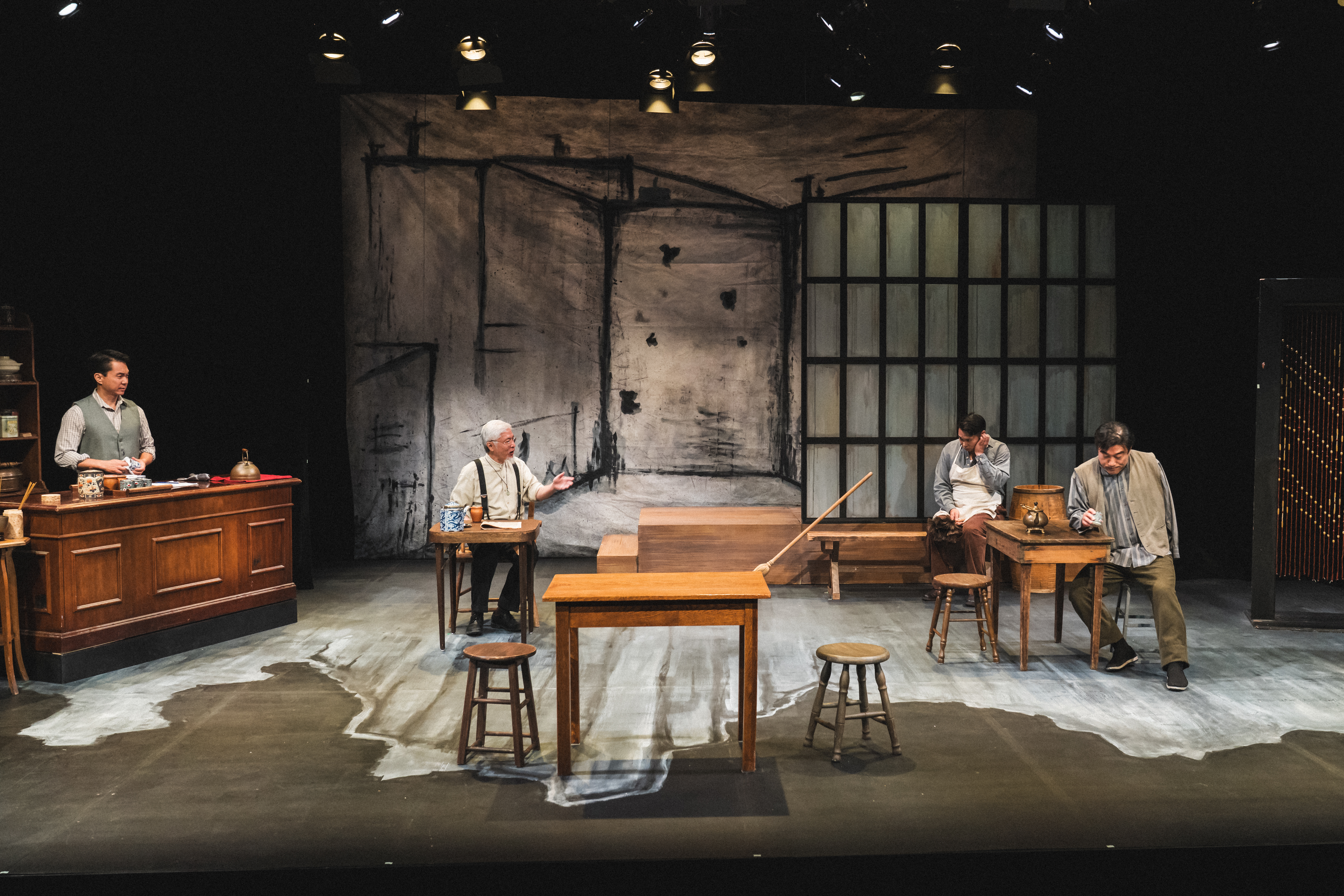
Photo by Lyon Smith
Kam’s text shines a light on a period of Canada’s history, from 1923-1947, which I certainly did not learn about in school. While the men of Bachelor Man focus primarily on the effects of The Exclusion Act, they also make reference to The Chinese Immigration Act of 1885, which affected even the eldest generation we see on stage. In doing some research about these laws for my interview with director Brenda Kamino, I was astounded at how little I knew about the subject, but was intrigued to learn more, particularly through this play. However, Kam not only works in the realities of life for the men affected by this law, but also the difficulties for queer people, for veterans of the First World War, and for the few women who made the crossing prior to The Exclusion Act. The hardship faced by the people in this play, for various reasons, pulls on your heartstrings; they’ve all gone through so much to be where they currently are, and yet what has Golden Mountain (their nickname for Canada) done for them in return?
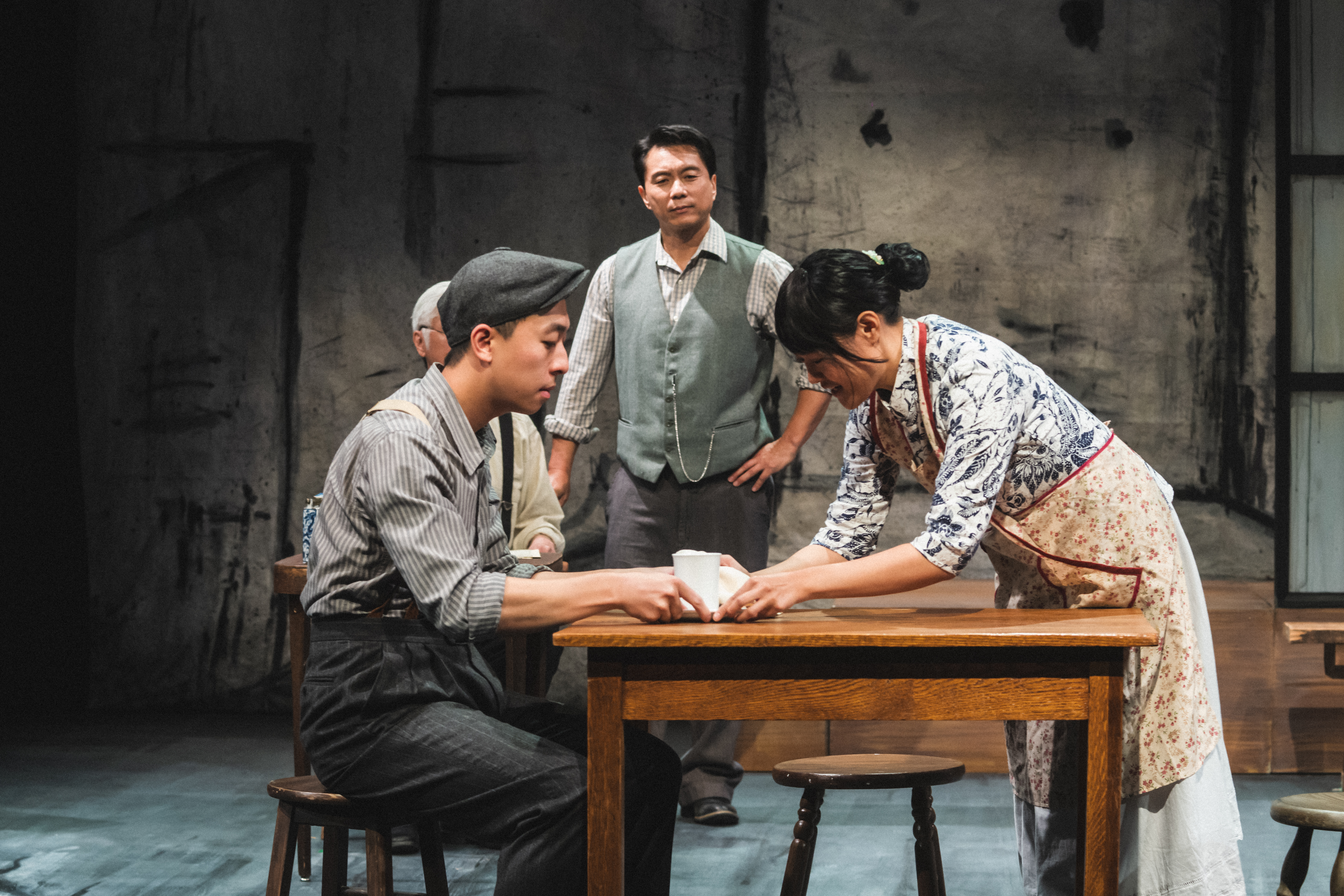
Photo by Lyon Smith
How they deal with these inequities is clearly defined by the generational gaps between the characters. Grandad and John are a bit older, and they have a very clear sense of tradition and doing things “the old way” and keeping to those ways even in Canada. The younger generation, comprised of Asi, Huang, and Kung, see things differently; when Queenie discusses the realities of her life, they’re intrigued and horrified and immediately strive to do better. Kao finds himself in the middle of things; he’s equally as appalled as the younger men, but immediately looks for validation from his elders. The gaps in these divides are vast, and they make for such a tense and interesting dynamic between the characters.

Photo by Lyon Smith
Jackie Chau’s design thrusts us into the heart of John’s Tea House: with an ink-wash painted backdrop to show the growing metropolis outside, and a screen and beaded doorway to indicate the entry points to the room, there are nods to the heritage of the characters everywhere you look. The men are dressed in plain clothes, with Earth tones and a decidedly 20’s look, while the women’s outfits stand out with their brighter colours. Even Queenie’s road-weary clothes were clearly the height of fashion in the recent past. The attention to detail from the Chinese characters on the chalkboard to the ornate teacups and matching tea pots gives a sense of how these men have made this run-down tea house their home.

Front: Sean Baek and Brenda Kamino
Photo by Lyon Smith
Brenda Kamino and Robert Lee are returning to Bachelor Man having been a part of the original production in 1987. Kamino’s Queenie comes in in the second act and makes her presence known immediately; Kamino is a fierce performer and yet her vulnerability in those powerful speeches brings tears to your eyes. Lee’s Grandad Lian is funny, harsh, and comforting all at the same time. Lee gives Grandad a wisdom and yet also a biting tongue which makes him delightfully unpredictable. George Chiang’s John is a strong and determined man, and Chiang certainly stands in that strength. His stage presence is undeniable, and like Lee’s Grandad, you never quite know who he might lash out at. Damon Bradley Jang plays Asi, the young man who works for John. He delivers the story-telling pieces in between scenes beautifully, and I enjoyed watching Asi watch what was happening in the room; even if Asi’s not allowed to participate, he’s still very actively listening to everything his elders have to say. Ziye Hu’s Huang stole my heart; he brings an honesty and tenderness to this character which makes him wonderfully different from the others. Likewise, Oliver Koomsatira’s Kung is shy and inquisitive, and Koomsatira embodies this character deftly. Renée Wong’s Madame Wu is so soft and gentle, a flower amongst the thorns of the tea house. Wong’s singing punctuates the play, telling us a story within this one: of the other side of the coin, the plight of the women of these men. Sean Baek gives a stunning performance as Kao. Not only is Baek’s physicality put to the test, but the emotional ups and downs of this character are great, and he allows the audience to experience all of this with Kao.
Renaissance Canadian Theatre’s mandate is to give second lives to productions which haven’t had them yet, and Bachelor Man is one that is definitely deserving of this second run. In a time where xenophobia runs rampant and we likewise rarely look up from our shoes (which are under our phones) as we walk along the street, Bachelor Man feels like glimpses to the past and present simultaneously.
Bachelor Man runs at the Tarragon Theatre Mainspace until September 14. For more information and tickets, visit: https://tarragontheatre.com/plays/2025-2026/guest-presentations-2025-2026/bachelor-man/
Cover Photo: Robert Lee, Damon Bradley Jang, and George Chiang. Photo by Lyon Smith.
Thank you to my Patrons:
N. Bushnik, S. Fisher, B. Kinnon, D. Moyes, E. O’Brien
And to my supporters who’ve bought me a coffee:
Angelica and Paul, Anonymous, Adrianna, Caitlin, Jonathan, Jada, and Courtney
Would you like to become a Patron? Check out my Patreon at: https://www.patreon.com/AViewfromtheBox
Or, you can buy me a coffee at: buymeacoffee.com/aviewfromthebox
 A View from the Box