Power. Prejudice. Vengance.
When a professor takes things too far with a struggling student, how will she retaliate? Will the professor be punished? Who can possibly win in this situation? David Mamet’s Oleanna, directed by Icarus Theatre’s artistic director Anthony Goncharov, is a scathing exploration of the abuse of power within academia. Featuring intriguing design and impressive performances, it truly comes down to Oleanna’s outdated text which left me wondering: why put on this play right now?
Carol goes into her professor’s office, without an appointment, to discuss her grades; she’s not doing very well and wants to know if it’s worth continuing in the course. John, her professor, is in the process of buying a new house. He’s about to get tenure and so he and his wife decide that it’s time to upgrade their dwelling too. This also means that their conversations are consistently interrupted by harried phone calls from his wife and real estate agent. But what starts as a simple, but inconvenient, visit escalates with every time Carol enters his office, culminating in the total collapse of John’s life as he knows it.
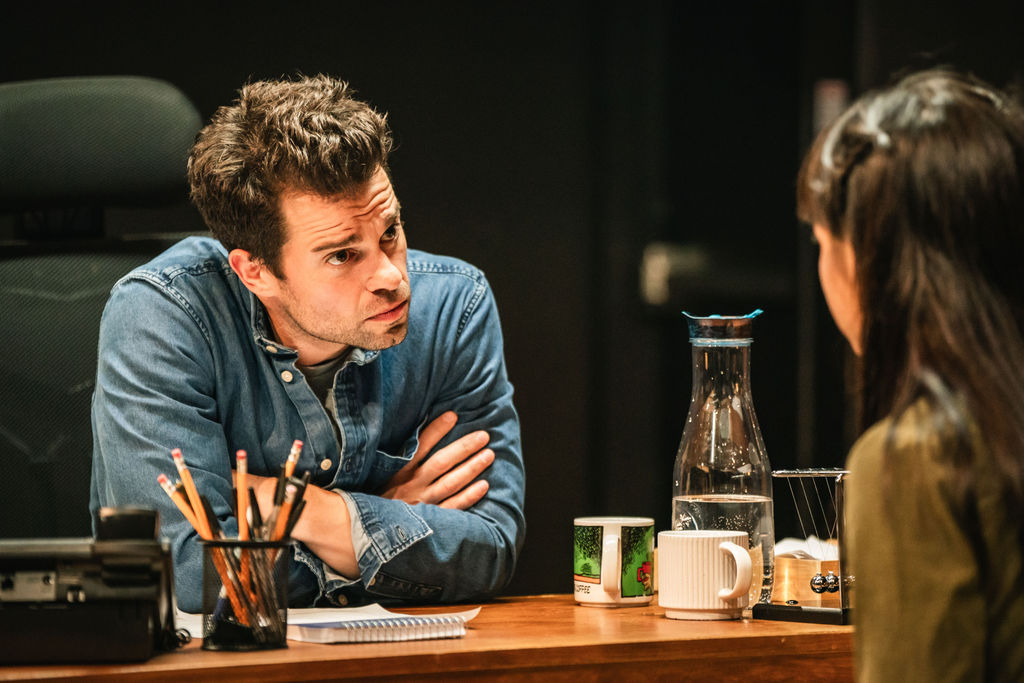
Photo by Elana Emer
However, the question remains: does he learn his lesson? As he stands there over his student after having physically violated her for the second time, there is at the very least a flash of recognition. A tiny bit of understanding that maybe she might be right. Yet there’s a sense that it doesn’t matter, that despite the fact that he was denied his tenure, lost the new house, and is suspended from the University, that he won’t stop. That he refuses to have enough empathy to actually understand how Carol is feeling. In a post #MeToo world, it feels difficult to understand why Icarus Theatre thought this play would resonate with its audiences. While it is impressive to see a young woman fight to bring her professor to justice, there isn’t a full sense, nor a full assurance, that justice will fully be served. And without that assurance, without some sense of closure, what does the play actually tell us? What message is it hoping to impart? That no matter what the system is designed so that men will always win? That no matter how hard we struggle, our victories are never complete wins? While exposing this type of behaviour may have been revolutionary in Mamet’s time, it lacks a modern sensibility.
The other interesting choice for this production is the casting. Though both performers are talented and handle the text well, their closeness in age takes away a good deal of the tension and power dynamics within the play. The professor should be much older than the student, thus enhancing both his power over her, but also the sense that he should know better than to be doing what he’s doing. Even if they’re maybe further apart in age than is detectable by sight, there still should be a significant difference in age between the two characters to help reinforce Mamet’s text.

Photo by Elana Emer
However, despite their similar age, Aris Athanasopoulos and Star Slade give powerful and intense performances. Mamet’s text requires them to frequently talk over one another and, especially in the first few scenes, rarely finish a thought, yet the two of them are able to do that dance well together. Athanasopoulos gives John an intensity which borders on the unhinged; constantly having to flip back and forth between student and distraction. There’s an arrogance to John which Athanasopoulos capitalizes on, making that character as uncomfortable to watch as he can. Slade’s Carol is initially sweet and innocent, confused and searching for approval. When she returns, Slade is allowed to unleash a calm ferocity which suits Carol perfectly. Her wide eyes allow for trust and ease while she says something totally opposite; a perfect combination for this show.
An element of the directing which I appreciated was how the two were clothed and how their layering worked (costume design by Emily Anne Corcoran). Initially John is in a full suit, with a denim shirt underneath, while Carol is wearing a simple camisole-style top. The next time she visits, she’s got a long sleeve shirt on and John’s jacket has been removed. In the third visit, John is down to a grey undershirt and Carol’s got a jacket over her long sleeve shirt, indicating the power shifts which have occurred. This was fascinating to watch, as the two quickly donned or deserted their various layers, and was a very visual representation of what was happening through the dialogue.
Bharat N Vyas’ set is likewise very suited to the text; wooden bookshelves, a large desk, and comfortable seating immediately indicate that it’s a professor’s office. However, an element which took me by surprise were the panels which create a small hallway to and from the office. They have the ability, at the flick of a switch, to be either opaque or see-through. These create moments we wish we could witness which we cannot, while also allowing us to witness violence we may not want to. I’ve not seen anything like this before, and really enjoyed how it was used throughout the production.
While Oleanna may have had shock value when it was first performed in 1992, there’s much of it which feels outdated and uncomfortable with no overt purpose or meaning for being so. This is something I’ve faced with Icarus Theatre in the past: that their play choices speak to a different era without being able to make them speak to this one.
Oleanna runs at the Tarragon Theatre Extraspace until August 30. For more information and tickets, visit: https://www.icarustheatre.ca/season2526
Cover Photo: Aris Athanasopoulos and Star Slade. Photo by Elana Emer.
Thank you to my Patrons:
N. Bushnik, S. Fisher, B. Kinnon, D. Moyes, E. O’Brien
And to my supporters who’ve bought me a coffee:
Angelica and Paul, Anonymous, Adrianna, Caitlin, Jonathan, Jada, and Courtney
Would you like to become a Patron? Check out my Patreon at: https://www.patreon.com/AViewfromtheBox
Or, you can buy me a coffee at: buymeacoffee.com/aviewfromthebox
 A View from the Box