Gather round the fire, the Storyteller is ready to weave their tale. Mahabharata is a story as old as words themselves, passed down through the ages and told many ways over, however this telling is sure to be unlike anything you’ve experienced before. Miriam Fernandes and Ravi Jain have brought the stories of Mahabharata to life in a way befitting the legendary status of the material. Simple yet splendid, Mahabharata Part 1 & 2 are unparalleled feats of storytelling.
Mahabharata Part 1 begins with the Storyteller, brilliantly played by co-creator Miriam Fernandes, telling the audience a tale of a snake whose home forest was burned to the ground by five brothers attempting to appease the Fire God. The Snake gets revenge, but not for several generations, biting the grandson of one of the brothers, who is now the king. The King’s son vows to get vengeance for his father, but is stopped by the Storyteller, who then begins to tell the story of the Kings’ ancestors. Over the rest of Part 1 and Part 2, the story of the Pandavas (the five aforementioned brothers) and the Kauravas, their 100 cousins, is told. It’s a story of blessings from the gods and the curses which accompany those blessings. Tales of vengeance, bloody battle, love, marriage, birth, and death, all within this royal family. It’s up to the new King, Janamejaya, to break the cycles begun by his ancestors and show what it truly means to embrace Dharma.
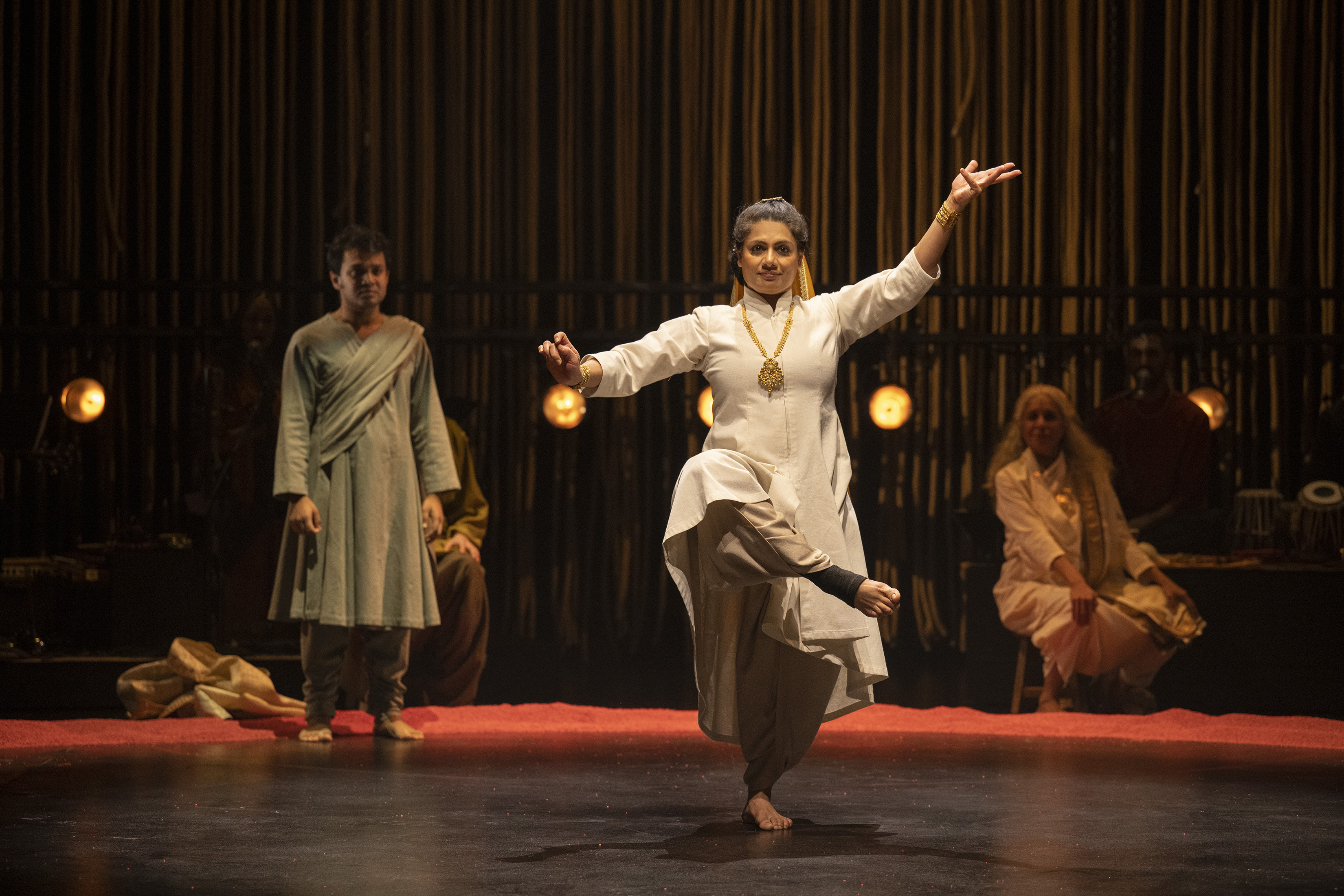
Yet these stories are not simply acted out before the audience, they’re told through song, dance, live video, and fierce fight choreography. Director and co-creator Ravi Jain has brilliantly embodied the longevity and multiplicity of Mahabharata’s myriad tellings in this singular retelling. There is background music throughout the production, with the musicians being live on stage for the whole of Part 1. Part 2 contains a Hindi opera expertly sung by Meher Pavri as the voice of the God Krishna. Jay Emmanuel and Ellora Patnaik both dazzle with their execution of Brandy Leary’s choreography; Emmanuel’s portrayal of Shiva is a whirl of constant movement. The use of screens and live video in Part 2 is a stark reminder that the cycles we see represented in Mahabharata continue, and this epic tale of destruction and revenge can easily be seen in today’s society.

Lorenzo Savoini’s set design is spare yet meaningful, able to be everywhere and nowhere, not tying the story to a singular place or time. The beginning of Part 1 allows the audience to see the full scope of the Bluma Appel Theatre – the stage is open straight to the back walls, with even some of the wing spaces able to be seen. As the story progresses, more set pieces are added to create the world of the players: fabric covers the wings to create more of an indoor feel, chandeliers come down from the ceiling which appear again in Part 2, along with chairs and tables and screens to create the war room which begins the second part. All of this is stripped away by the final scene of the play, beautifully returning players and audience alike to where we began.
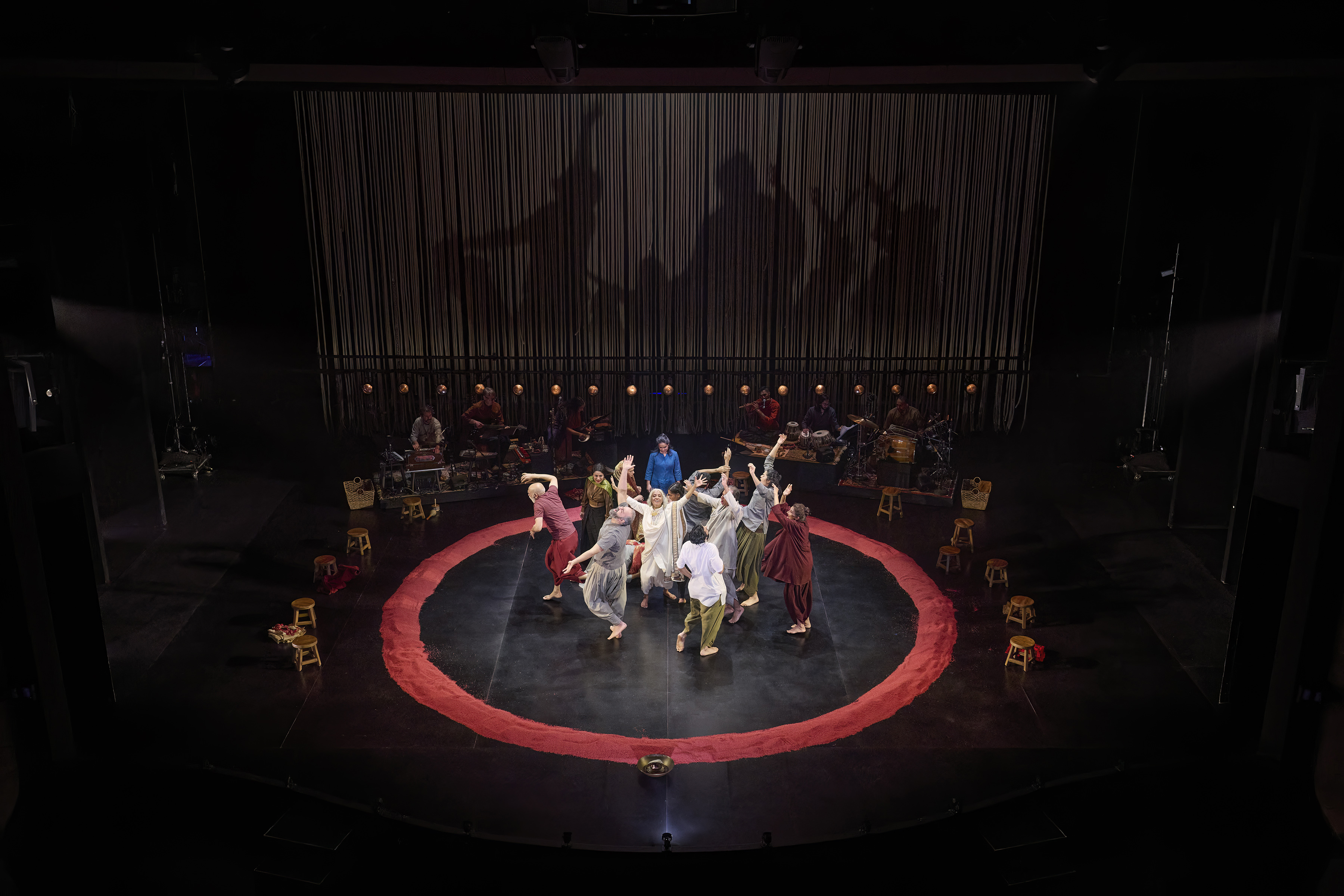
The symbol of the circle is ever present throughout Mahabharata. Part 1’s set has a giant red circle on the floor, which initially denotes the playing space from where the actors are sitting outside and observing the story. The royal families of the Pandavas and Kauravas are therefore contained and created within this circle. At the end of Part 1, Jay Emmanuel as Drupada, destroys that circle, dancing through it with rage after he has been insulted by Drona, a guru and warrior. The destruction of the circle foreshadows the destruction of the family as they inevitably turn against one another. The massive ring of light which descends during Part 1 looks like the moon covering the sun during a total eclipse, yet within its meaning lies the whole universe. The destroyed circle on the ground remains for Part 2, scattered yet still circular. Shiva, in his perpetual destruction, smears it further throughout the battle between the family.
However, one thing I can’t get out of my head is the image of the snakes dangling in mid-air while the Storyteller regales Janamejaya with this story. They’re hanging in the air, straight down like the ropes which create the background of the stage. But there’s such an iconic image of the snake eating its own tail, the cycle of birth and death, and that circle is constantly present as well. It’s like those snakes are able to remain straight only until Janamejaya decides if he is going to kill them all or not: will he have them eat their own tails and perpetuate the cycle, or has he learned the meaning of the stories he’s being told?
Mahabharata boasts a cast of incredible performers making these characters larger than life. Many of them have been part of previous productions of Mahabharata before now, and you can feel their passion for this piece radiating from the stage. An element which really spoke to me was how the gender of the performer and the gender of the character weren’t always the same; it speaks to the notion of a lack of gender binary pre-colonization. Rather, no matter who they were playing each cast member embodied their fabled characters with tenacity and charisma. Darren Kuppan is a perfectly despicable villain as Duryodhana, along with Sakuntala Ramanee as Shakuni. Shawn Ahmed, Munish Sharma, and Anaya Maharaj-Sandhu are amazing as the Pandavas. Navtej Sandhu has a beautifully commanding presence as Karna. Sukania Venugopal plays a powerful Bhishma. Neil D’Souza and Jay Emmanuel are asked to literally embody Gods and they to so with reverence and humour in equal measure. Ravin J. Ganatra, Goldy Notay, and Ellora Patnaik are elegant and regal in their roles. Though many of them play multiple parts, Gillian Gallow’s exquisite costumes allow for clear delineations between characters and families alike.
Part 1 of Mahabharata is called “Karma: The Life We Inherit” while Part 2 is entitled “Dharma: The Life We Choose.” These titles perfectly encapsulate the message of Mahabharata: that the life we’re given does not have to be the life we choose. We can always change our paths, find our way towards our own sense of Dharma. Breaking cycles of trauma and revenge is hard work, but it’s the work of each generation to do so. Mahabharata is a message of hope, peace, change, and forgiveness we need to hear now more than ever. The final image speaks volumes: the cast illuminated by fire and footlights, their shadows dancing on the back wall of the theatre. We’re back to telling stories around the fire, back to where we started, the circle is complete.
Mahabharata is playing at the Bluma Appel Theatre. Part 1 runs until April 26 and Part 2 runs until April 27. For more information and tickets, visit: https://www.canadianstage.com/shows-events/mahabharata
Cover Photo: : Miriam Fernandes as the Storyteller, with Anaka Maharaj-Sandhu as Arjuna and Neil D’Souza as Krishna in Why Not Theatre’s Mahabharata (Shaw Festival, 2023). Photo by David Cooper.
Thank you to my Patrons:
N. Bushnik, S. Fisher, B. Kinnon, D. Moyes
And to my supporters who’ve bought me a coffee:
Angelica and Paul, Anonymous, Adrianna, Caitlin, and Jonathan
Would you like to become a Patron? Check out my Patreon at: https://www.patreon.com/AViewfromtheBox
Or, you can buy me a coffee at: buymeacoffee.com/aviewfromthebox
 A View from the Box