Everyone has their own secrets, but when Kai’s mother unexpectedly passes away, she discovers that her mother had been keeping plenty of secrets…about Kai. Carried by the River, written by Diana Tso 曹楓 and directed by William Yong 楊漢源 is about the importance of both ancestry and discovery, told through the eyes of a queer Chinese-Canadian woman. Combining elements of theatre, dance, and puppetry, Carried by the River is visually spectacular with a story that’ll touch your heart.
Kai is having a hard time dealing with her mother Rose’s passing; she’s totally bereft and alone in the world. Going through her mother’s belongings, she discovers an envelope which contains, to her utter shock, her adoption papers. Opening up a world of questions, along with a great deal of pain and anger, Kai doesn’t know what to do. After being visited by a talking tiger, she decides to go and attempt to find her birth mother in China. Upon arrival, she meets another young lady, Ting Ting, who has a sister whom she’s never met as she was given away at birth (due to China’s 1 child policy). Thinking the sisters have finally found one another, Kai and Ting Ting begin to get to know one another, and Ting Ting even takes Kai to meet her mother Mei Shan and Grandma (you can call her Lao Lao). However, as more truths unfold, Kai discovers that these amazing women might not be her birth family, but they have certainly chosen her to become a part of theirs.
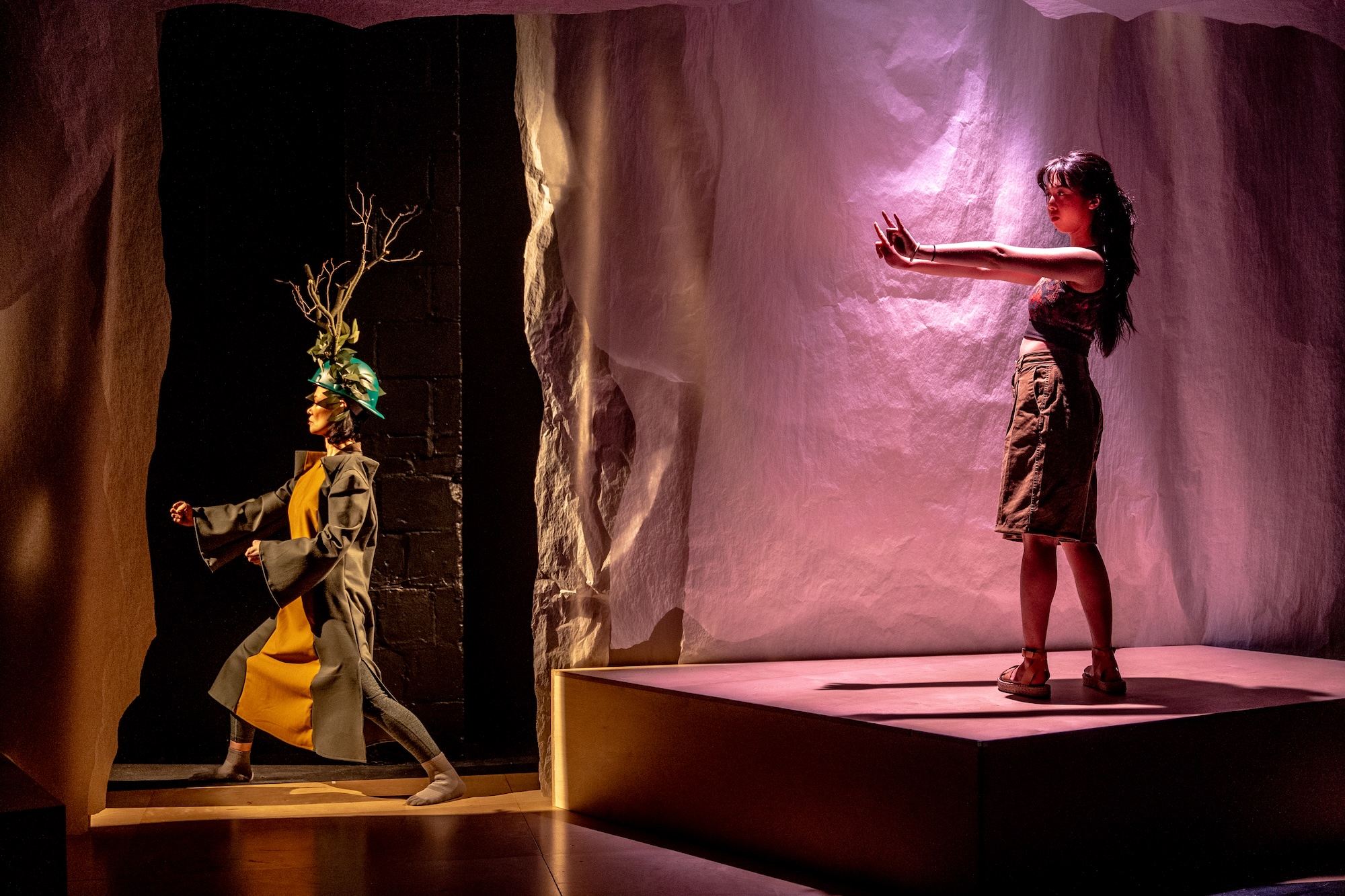
Photo by Dahlia Katz
The elements of dance, shadow artistry, song, and magical realism make Carried by the River a remarkable experience. Kai can talk to animals, and these animals are portrayed beautifully by the other members of the cast; the physicality, particularly of the Tiger and Deer, is incredible. There’s a real flow to the text, and yet you never quite know if you’re in a state of dream or awake with Kai. Also, the supernatural elements to the production are really fun (Lao Lao is more annoyed than anything that she can talk to the dead: “They’re so chatty!”) but also a moving homage to the importance placed on ancestors and communication with them in Chinese culture. Because Kai is new to the country, a great deal of the symbolism and festivals discussed in the play is explained within the context of the play itself in a way which leaves no audience member behind.
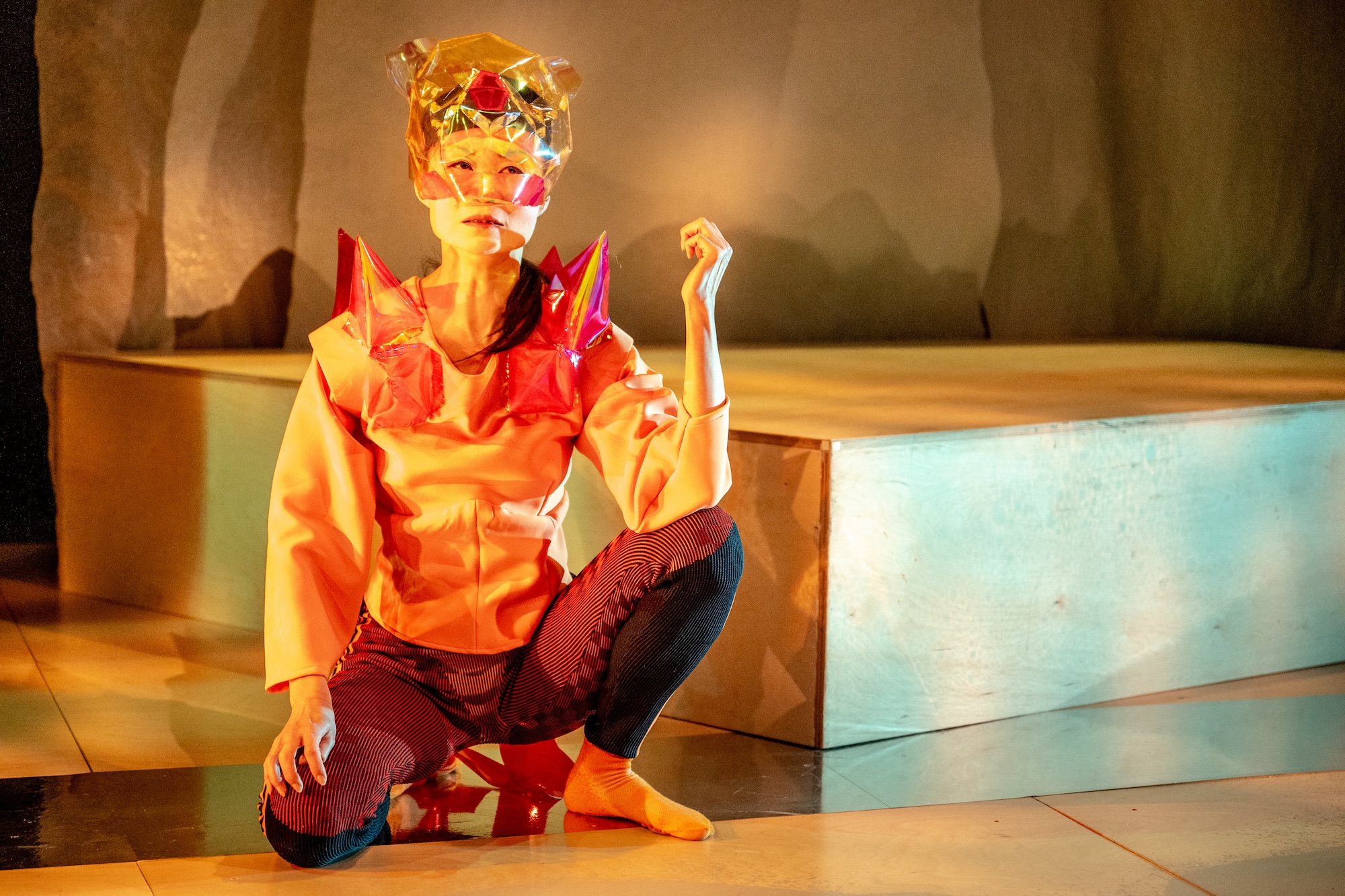
Photo by Dahlia Katz
Ting-Huan 挺歡 Christine Urquhart’s scenic design is calming and clearly inspired by nature with its neutral tones and light wood set pieces. The paper drapes which hang to the side of the stage and from the ceiling create an almost cave-like appearance, while allowing the light and projections to play off of them easily. The costumes are impressive; I have no clue where they found those bubble shirts which we were all wearing in the early 2000’s, but they somehow suited Ting Ting and Kai so perfectly. Of course, the highlights are the costumes for the animals: the Tiger is warm colours of translucent plastic, the Deer’s antlers are made of twigs to match the rest of the Earthy tones, and the Bear is so plush and cuddly looking that you just want to squish them. The embodiment of Money somehow has a little lucky cat in her shirt and I gasped at how cool it was. Everything feels so perfect for the characters while also fitting into the zen feeling of the production.

Photo by Dahlia Katz
A stunning all-female cast is the heart and soul of Carried by the River. Honey Pham stars as Kai; her vulnerability and honesty in this role are so necessary, especially considering everything her character goes through. Michelle Wang is making her professional theatre debut as Ting Ting, and you would never know that this is her first professional gig. Her charisma and energy make her a bright light in the production, and her chemistry with Pham makes it feel like they’ve known each other forever. Tai Wei Foo 符岱微 plays Mei Shan, Ting Ting’s mother. She gives a beautifully moving performance and as previously mentioned her Tiger is sleek and intimidating. Shiong-En Chan’s Rose is beautiful and caring, the kind of mother every queer child wishes for. Chan is elegant and seemingly floats on and off stage. Brenda Kamino stole my heart as Lao Lao; she is your no-nonsense Granny who’s sick of a lifetime of spirits nagging her. Kamino’s comedic timing and sassy delivery makes everything she says either hilarious or deeply profound, and sometimes both.
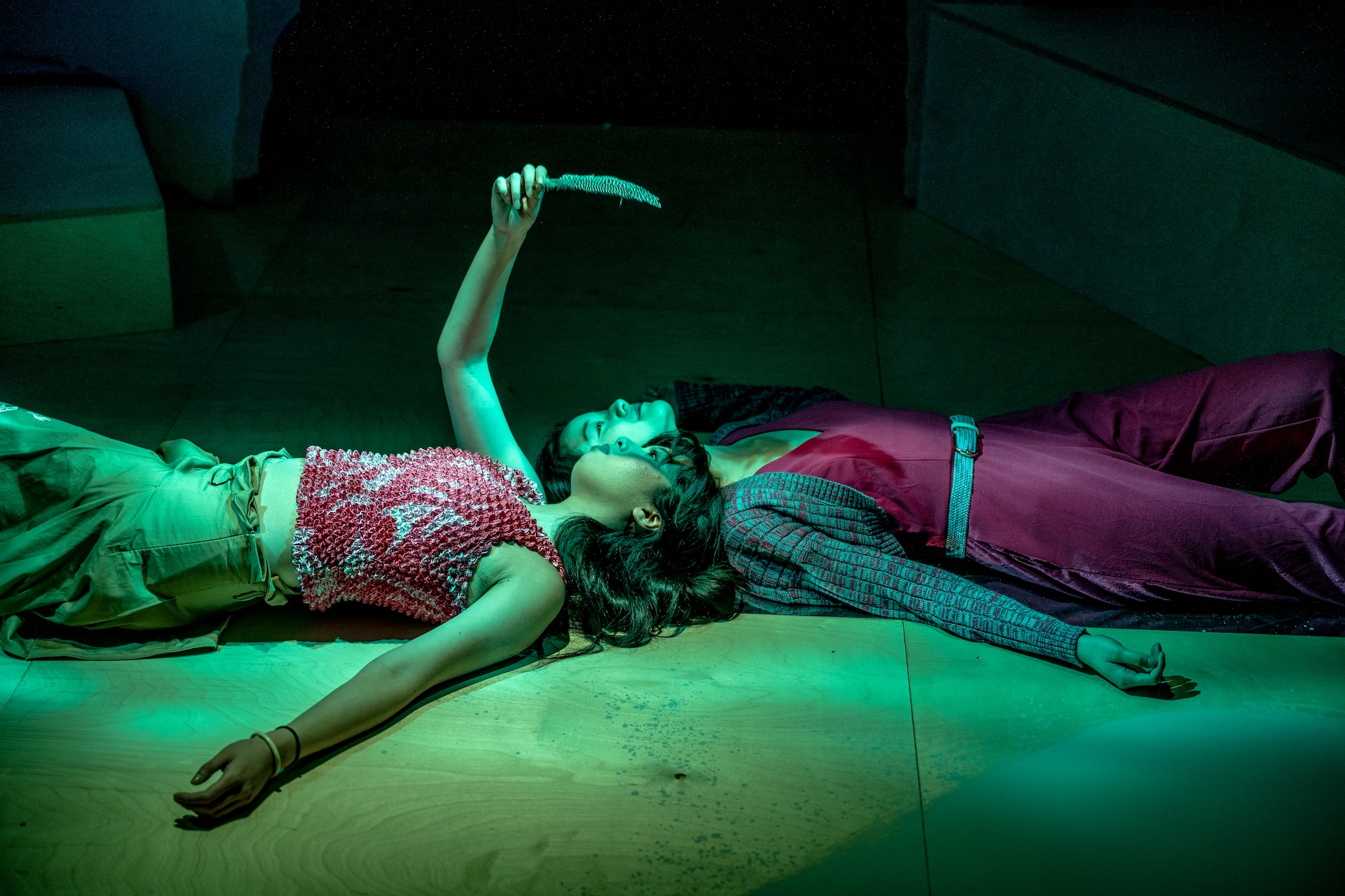
Photo by Dahlia Katz
Throughout the play, the women come back to the river – though these rivers are worlds apart, each generation feels their own deep connection to the rushing waters and beautiful wildlife which surrounds it. Showing not only its delights but also its dangers, Carried by the River grounds these women in the muddy banks of their beloved homes. The notion that one day they’ll turn into the river, become part of its ferocity and its stillness, unites the women: it’s their red thread.
Carried by the River plays at the Tarragon Extraspace until March 23. For more information and tickets, visit: https://tarragontheatre.com/plays/2024-2025/guest-presentations/carried-by-the-river/
Cover Photo: Shiong-En Chan, Tai Wei Foo, Brenda Kamino, Honey Pham, and Michelle Wang. Photo by Dahlia Katz.
Thank you to my Patrons:
N. Bushnik, S. Fisher, B. Kinnon, D. Moyes
And to my supporters who’ve bought me a coffee:
Angelica and Paul, Anonymous, Adrianna, and Caitlin
Would you like to become a Patron? Check out my Patreon at: https://www.patreon.com/AViewfromtheBox
Or, you can buy me a coffee at: buymeacoffee.com/aviewfromthebox
 A View from the Box