Six women – three Muslim, three Hindu, a truck, and a country fractured by the actions of foreigners. Anusree Roy’s heartbreaking yet hopeful play Trident Moon is piercing look at Partition and the harm it caused families as India fought for independence. Beautifully directed by Nina Lee Aquino, this thought provoking story and its powerful performances will stay with you long after you’ve left the theatre.
Through the initial darkness, Jawon Kang’s set looms large: the drapery cascading from the ceiling to the raked stage creates a feeling of everywhere and nowhere. As the house lights dim, a large fissure of light cuts the stage in two, a clear representation of the division occurring in the outside world. The sides of this fissure are carefully adhered to as the women enter the back of the truck with Rabia (a regal and powerful Imali Perera), Pari (with a passionate and determined Muhaddisah) and Heera (a perfectly childlike performance by Prerna Nehta) bound as prisoners on one side of the truck with Alo (Anusree Roy gives her lead a feisty and fearsome edge), Bani (Sehar Bhojani is funny yet tragic), and Arun (a vulnerable and emotional performance from Sahiba Arora) on the other. Bani has been shot and is bleeding badly, and her sister Alo is doing her best to stop up the wound while also keeping the occupants of the truck quiet. The prisoners are trying to call for help, but this is only more likely to get them all killed.
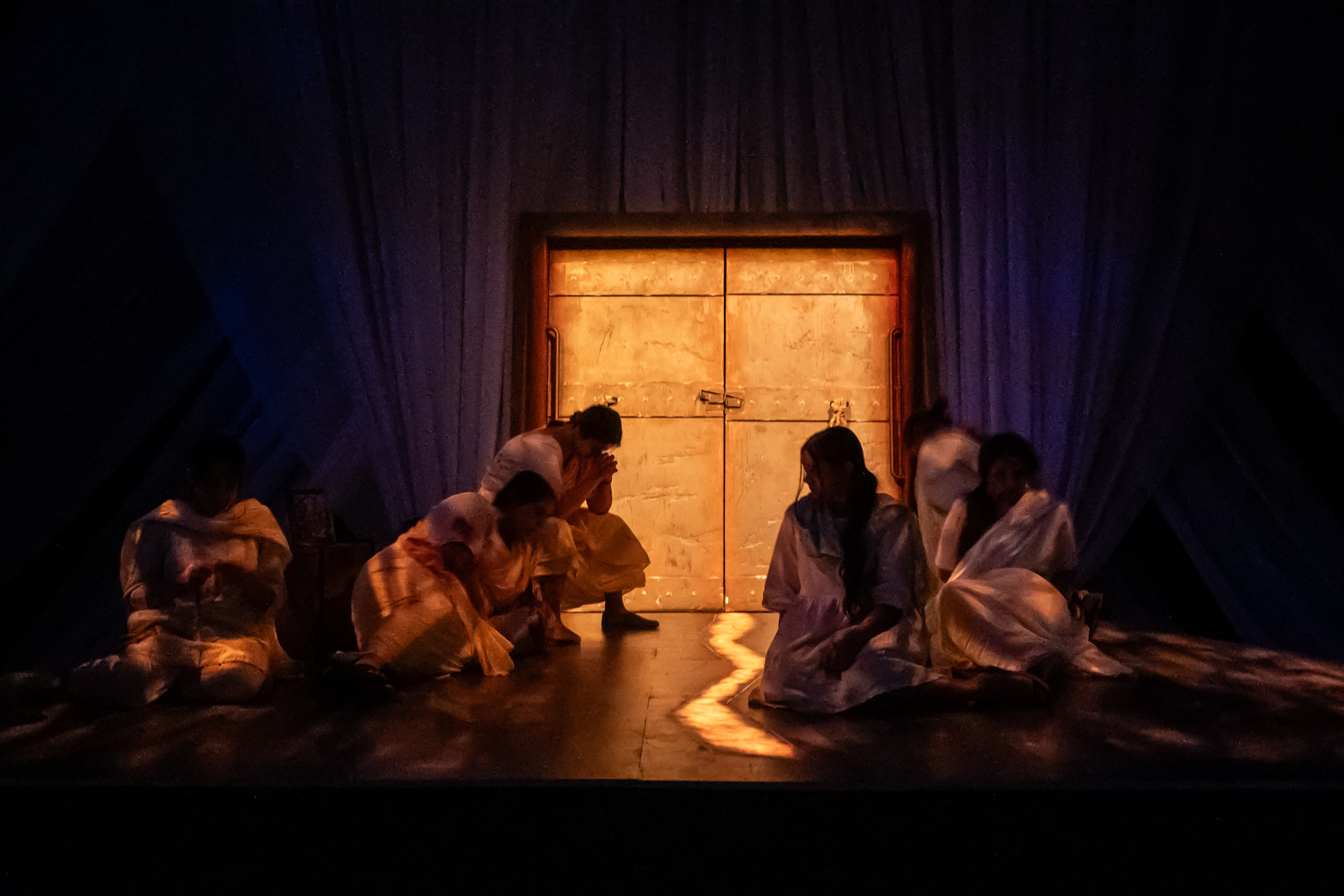
Photo by Dahlia Katz
Ming Wong’s costumes clearly identify and ally the characters with one another – Alo, Bani, and Arun wear saris of a warm, deep yellow, while Rabia, Pari, and Heera wear light blue ones. When Sonali (the ever charming and fiery Zorana Sadiq) enters, wearing an orange scarf around her neck and light orange clothing, we’re meant to immediately understand that she’s more aligned with Alo and Bani than Rabia or Pari. Sonali is very pregnant, and with twins! “Small baby big baby” as Arun happily chants. Her husband has gone missing, yet as a Sikh it was no longer safe for her to stay in her home, so she threw herself into the middle of the road to ask the driver for help. Though she’s rather chatty and the other women, whose tension with each other has only grown as the trip progresses, find it grating. Yet Sonali will prove herself rather useful as the journey progresses.

Photo by Dahlia Katz
When the truck stops for a second time unscheduled, Alo is furious. At the truck’s door are Sumaiya (the stately and maternal Afroza Banu) and Munni (Michelle Mohammed, whose physicality is unmatched), an elderly lady and a young woman travelling together. The old woman is in a black burka, and the young girl is in a deep red dress which is beautifully adorned with sparkles and decorations. Sumaiya swears that she is Hindu, and just pretending to be Muslim to escape to India, and that she paid the driver quite handsomely to gain passage on the truck. However, once the burka is off and the light blue sari is revealed, Alo (along with the audience) begins to have doubts about the validity of their stories.
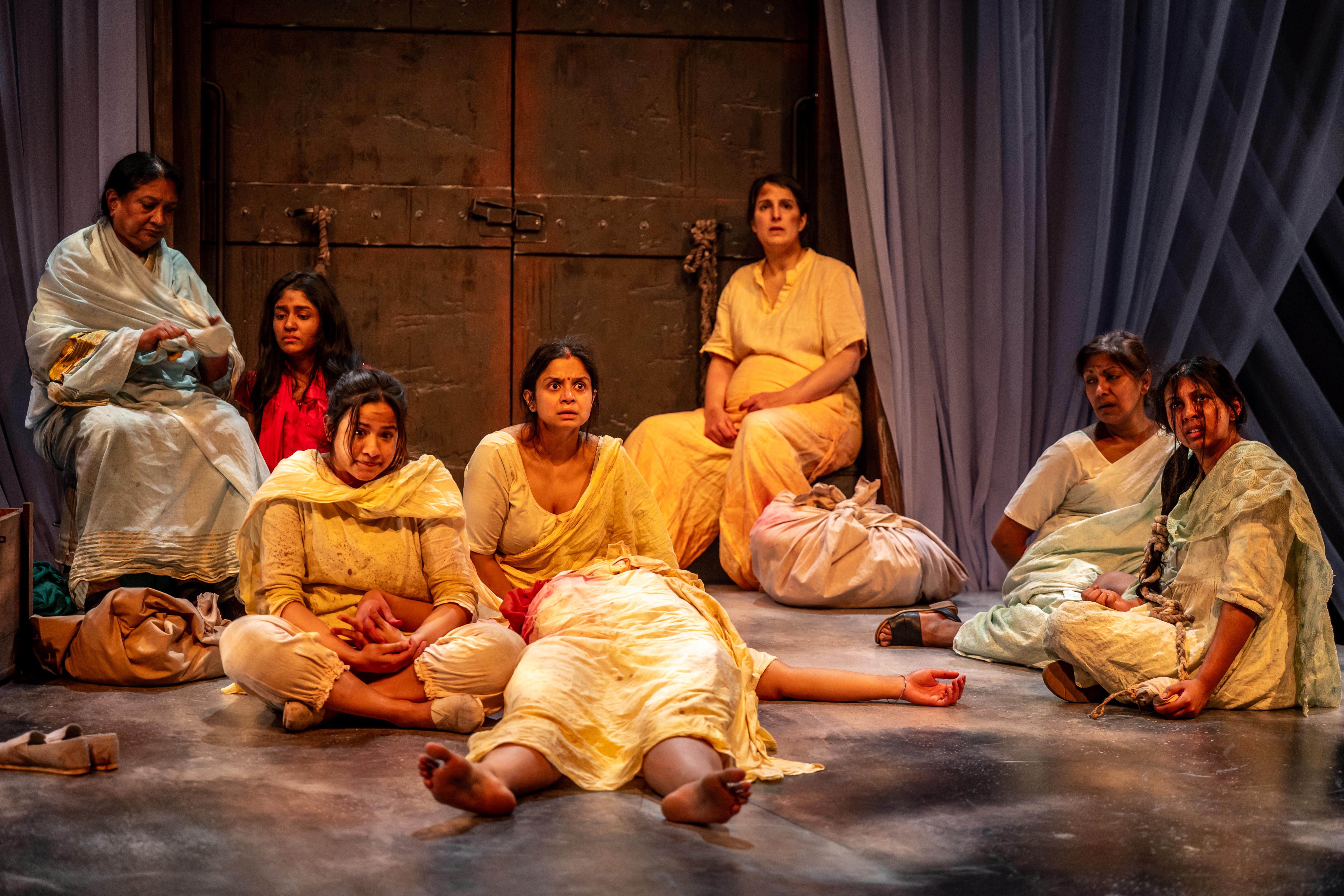
Photo by Dahlia Katz
Another unexpected stop, another bang on the back of the truck. A man enters (a troubled and uncertain Mirza Sarhan) demanding more gold from the women; he had found some on the driver, so he knew they must have more, and he intends to find it by any means necessary. After violating all of the women, including the three children on board, he’s more furious than ever. Yet Alo’s passionate plea thankfully does not fall on deaf ears and they’re able to continue on.

Photo by Dahlia Katz
This breathtaking story concludes with the sounds of the hustle and bustle of an Indian city. Romeo Candido’s sound design is paramount to the tension of the play; listening to the crunching footsteps of the men circling the truck, the constant hum of the motor and the screech of the brakes. You can especially notice the silences – suddenly in a room full of people you can hear a pin drop as we call hold our breath, rapt to the story. Yet as the sun rises and the lighting suddenly changes from cool to warm, you feel a sense of hope that these women will be okay and will find a new life in this new India.
I was ashamed at how little I knew about Partition until recent years; elements of popular culture like “Ms. Marvel” or the novel “Independence” by Chitra Banerjee Divakaruni have offered glimpses into the time and circumstances. What I often forget is how recent this was: 1947 is still within living memory, and these experiences would be impossible to forget. Trident Moon pays homage to the tenacity and ferocity of the people who fled to the promised safety of their new countries, as well as refusing to shy away from the realities of the brutality and bloodshed.
Trident Moon runs in the Guloien Theatre until March 30. For more information and tickets, visit: https://www.crowstheatre.com/whats-on/view-all/trident-moon
Cover Photo: (L to R) Imali Perera (behind), Michelle Mohammed, Prerna Nehta, Zorana Sadiq (behind) Sahiba Arora, Sehar Bhojani (lying down), Anusree Roy, and Muhaddisah in Trident Moon. Photo by Dahlia Katz.
Thank you to my Patrons:
N. Bushnik, S. Fisher, B. Kinnon, D. Moyes
And to my supporters who’ve bought me a coffee:
Angelica and Paul, Anonymous, Adrianna, and Caitlin
Would you like to become a Patron? Check out my Patreon at: https://www.patreon.com/AViewfromtheBox
Or, you can buy me a coffee at: buymeacoffee.com/aviewfromthebox
 A View from the Box