Come in! The Shabbat table is set, the challah is warm, and Shylock is expecting you. Shakespeare BASH’d is shedding new light and focus on one of Shakespeare’s most controversial plays with their production of The Merchant of Venice. Featuring a predominantly Jewish team, this production of Merchant does not shy away from anyone’s faults be they Christian or Jew, creating one of the most complete versions of the play I’ve witnessed.
Julia Nish-Lapidus’ vision for this production is clearly felt from the first moments you enter the space until the final light goes out; the subplot of this play (because it technically is the sub plot to the romantic main plot) is riddled with anti-Semitic language and stereotypes. Instead of shying away from these, Nish-Lapidus ensures they’re all left in, every jab, every slur, ensuring that the audience gets a grasp of the climate of the world for Shylock (played by Alon Nashman) and his friends. However, she’s also ensured that none of the characters come away unscathed from this production – they are all somehow complicit in how things end.
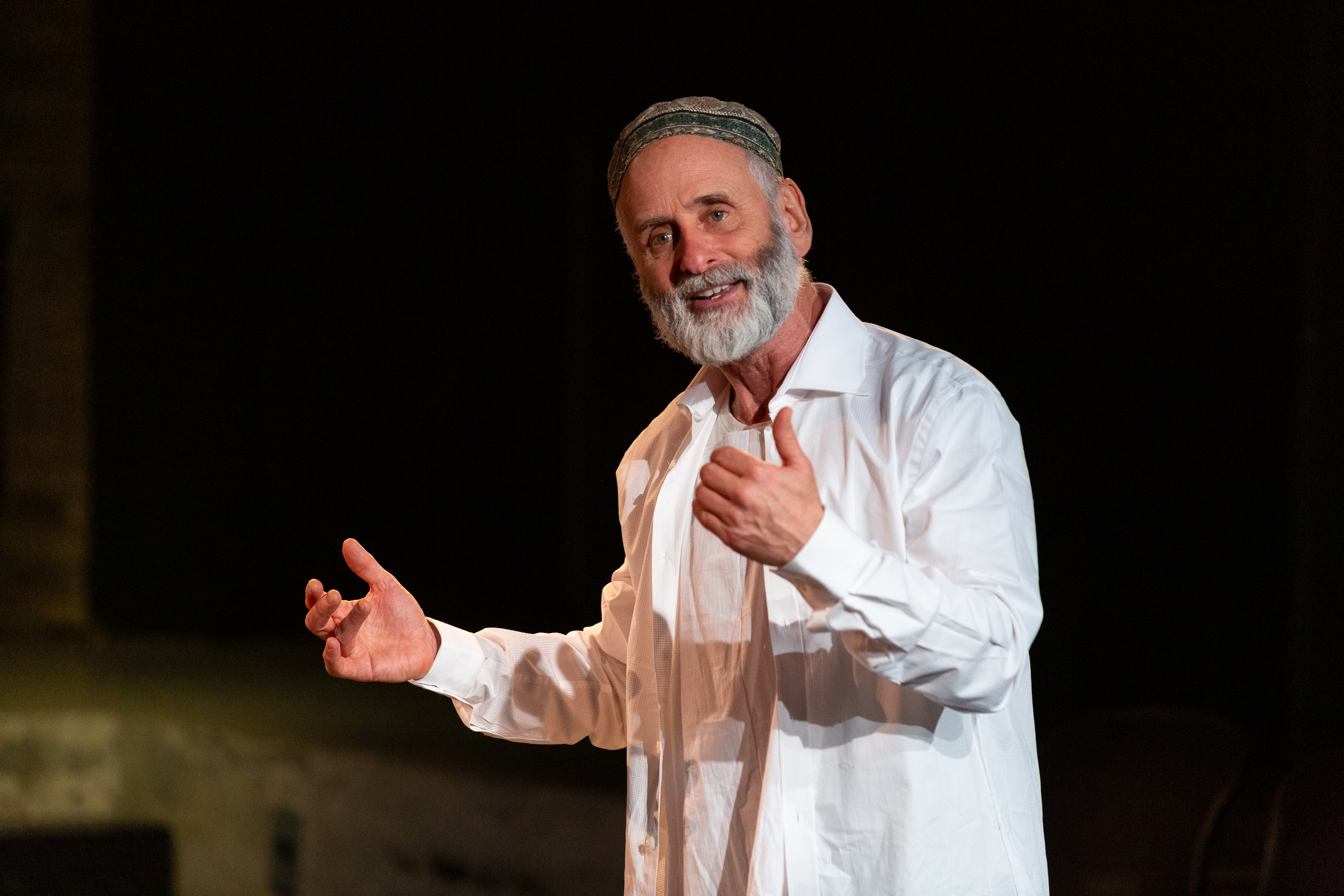
Photo by Kyle Purcell
The addition of the opening and closing scenes, brief vignettes of Jewish domesticity, bring a familiar atmosphere to the production while also highlighting Nish-Lapidus’ vision. To start the play by quoting the most quoted, and mis-quoted, lines from The Merchant of Venice reminds the audience that this story has proliferated throughout our society, including turns of phrase we often use, though not all of them are used in the context in which they were initially written. At the end of the play, the Shabbat table has been reset, and now it’s Jessica’s turn to light the candles; a not-so-subtle way of implying that Jessica (Cameron Scott) chooses to not adopt the Christian life she’s run away for. However it’s also emblematic of the generational trauma which has made its way to Jessica; she’s had to hear second-hand about what’s happened to Shylock and this clearly deeply disturbs her. It’s a portrayal unlike I’ve seen before and Scott does a spectacular job with it.

Photo by Kyle Purcell
As previously mentioned, none of the main characters escape this production without some level of complicity in the events which have occurred. Antonio’s (Jesse Nerenberg) hatred for Shylock is brought to the fore; his loud protestations to Bassanio (Cameron Laurie) about the money lender are fearsome, giving him a dark side we don’t often get to consider as deeply as this production allows. Even Lorenzo (Ori Black) who we usually admire for his love for Jessica has a quality to him where you can tell that he’s not thinking as deeply about Jessica’s feelings, particularly once they arrive in Belmont, as he could be. These are just two examples which stood out as traditionally we think of these men as hero figures, yet without changing a word of how they’re written, they certainly are not. The Merchant of Venice is classified as a comedy in the First Folio as it follows New Comedy traditions (the wills of the fathers preventing their daughters to get married are circumvented and everyone gets married. The end), yet this production is a prime example of how our modern understanding shifts this into the category of problem play. By giving the audience, as well as the performers, the space to grapple with the issues presented by the play, it emerges as a whole other being from what we’re taught in high school or university.

Photo by Kyle Purcell
The costume design adds to the vision of how these issues persist today as the characters wear modern dress. The details are where the message lies, however: the prayer shawl constantly peeking out from Shylock’s shirt and his Bukharian kippah, which remains on stage long after he does, these important garments being front and centre are consistent reminders of who and what we’re dealing with. Accompanied by Matt Nish-Lapidus’ brilliant sound design, which incorporates Jewish music from all over the globe, there’s never a break in the continuity of the story.

Photo by Kyle Purcell
Alon Nashman gives an honest and passionate Shylock; he delivers one of my favourite speeches in Shakespeare, “Hath not a Jew eyes?” with heartbreaking humanity. Jesse Nerenberg’s Antonio is fierce, and the portrayal of his love for Bassanio potentially being a bit more than friendship is very intriguing and was well performed! Cam Laurie’s Bassanio is one of the few forgivable main characters in the play, and Laurie brings a kindness to Bassanio that makes you understand why Portia is so smitten with him. Hallie Seline’s Portia has a gravitas and boldness which makes the character truly her own; she stands in Portia’s power and lack-thereof beautifully. Seline’s chemistry with Laurie is palpable, as was her friendship with Brittany Kay’s Nerissa. Kay’s sweet yet feisty Nerissa is a perfect companion to Seline’s Portia, as well as to Asher Rose’s hot-headed Gratiano. Rose is a force in every scene they’re in, bringing a vivacity and ferocity to the character. Sofía Contal’s Launcelot Gobbo is a total scene stealer; with each new entrance some new amount of chaos occurs and it’s glorious. Cameron Scott gives a heartbreaking performance as Jessica; her decline and silence in the final act spoke volumes. Ori Black gives Lorenzo a one-of-the-guys kind of attitude which we’re not used to seeing, yet suits this production perfectly. Arielle Zamora and Adriano Reis are Solanio and Salerio respectively, and like Black are all too chummy with Antonio and supporting his world views. Caroson Somanlall and James Wallis round out the cast playing various roles and both deliver delightful performances.
Julia Nish-Lapidus says in her Director’s Note that she’s struggled with The Merchant of Venice for a long time, and I can totally understand why. Yet from that struggle this production has emerged with its understanding, fearlessness, and poignancy. It shows us why The Merchant of Venice remains a work which not only deserves to be performed, but to be questioned, analyzed, and interpreted in more ways than we’ve previously thought possible. Hopefully, there will be a day when The Merchant of Venice purely becomes a product of its time, where we no longer treat each other with such hatred. Until then, I truly hope for more productions like this one, which force us to look at ourselves and our roles in what’s happening in the world.
The Merchant of Venice runs at The Theatre Centre’s BMO Incubator space until February 23. The run is currently sold out, but there is the potential for rush tickets so check the website for more information on those: https://www.shakespearebashd.com
Cover Photo: Hallie Seline, Cameron Scott, Alon Nashman, Jesse Nerenberg. Photo by Kyle Purcell
Thank you to my Patrons:
N. Bushnik, S. Fisher, B. Kinnon, D. Moyes
And to my supporters who’ve bought me a coffee:
Angelica and Paul, Anonymous, Adrianna, and Caitlin
Would you like to become a Patron? Check out my Patreon at: https://www.patreon.com/AViewfromtheBox
Or, you can buy me a coffee at: buymeacoffee.com/aviewfromthebox
 A View from the Box