Power. Deception. Lust. A perfect storm of emotions for some after-dinner drinks, wouldn’t you say? Edward Albee’s seminal work Who’s Afraid of Virginia Woolf?, directed by Brendan Healy, is like watching an acting masterclass in the most chaotic, yet breathtaking, way possible. Legendary performers bring these iconic characters to the Bluma stage in this highly-anticipated production. Grab a stiff drink and settle in, because this is a story you won’t soon forget.
George and Martha have just returned home from a large faculty function; George works for the college and Martha’s father is the president. Martha informs her husband that she’s invited over a couple she met at the party for a night cap. Though initially not pleased with the potential for the night to drag on any longer, the doorbell rings faster than George can do anything about it. A young couple, Nick and Honey, appears at the door, and after a fair amount of cajoling, they come in for what they also assume to be a quick get together. Several hours later, and there’s been dancing, far too much drinking, vicious games, lying, cheating, laying on the tiled floor, and shattered glass the carpet. Irreparable damage has been done, to everyone, and yet there’s a sense that this is just another weekend in the lives of George and Martha.

Photo by Dahlia Katz
What fascinates me about Albee’s text is that there doesn’t seem to be an overarching message or meaning for the play. The characters themselves don’t say or do anything uniquely profound, and yet this play endures as a classic of the stage and a must-see for theatre lovers. Essentially, it comes down to how they say what they’re saying and the portrayal of the various tensions in the room which make it riveting despite its three hour run time. The highs and lows of this play are intense, and Albee’s understating of the power dynamics not only in the domestic sphere but how those bleed out into the every day are impressive. It’s an odd little slice of mid twentieth century life, and yet the stakes are beyond the every day because of the social positions these couples occupy.

Photo by Dahlia Katz
Julie Fox’s massive set design uses every inch of the stage to create George and Martha’s living room. The room itself feels larger than life; the walls stretch all the way up to the ceiling, yet with very little art or decoration they feel oddly empty for how much space there is. One wall is entirely reflective, a very posh style choice for the time, and yet the full effect of that reflective wall isn’t able to be fully appreciated by the aisles on the right side of the house. When the set was initially revealed, I was perplexed as to why the sofa and chairs were facing away from the audience. I thought to myself “doesn’t this whole thing essentially take place on that couch?” What I hadn’t spotted was the cleverly disguised revolve nestled in the navy blue shag carpet. This revolve is used to highlight the more twisty parts of the dialogue as the room spins with the thoughts of the characters. On the one hand, the size of the set is impressive; it can likely barely hold the amount of emotions which are going to emerge from it. On the other, it lacked a certain claustrophobia which can really have an impact on this play. I didn’t feel like I was in the room with the actors; they were actually rendered so small by the size of the set that it was difficult to see their faces from where I was sitting. Fox’s costume design does make an impact no matter where you’re observing the play from. George’s frumpy professor look is in stark contrast to Nick’s clean suit. Martha’s several outfit and wig changes are so symbolic of the personalities she puts on throughout the night, finally emerging as her vulnerable self. Everything about Honey is the magazine image of the perfect housewife from her dress and cardigan to the little slippers she brings along with her.

Photo by Dahlia Katz
The dichotomies between each couple are perfectly portrayed by this cast. The women, in particular, are vastly different. Honey, played by Hailey Gillis, is demure and kind, if a little flighty. Her real verve comes out when she drinks, and Gillis’ vibrant performance in these moments is hilarious. She uses every inch of that stage when she “dances.” However Martha, played by Martha Burns, knows her power and is not afraid to use it. Burns radiates ferocity from the top of her head to the soles of her feet and you can feel it surging through the room. Yet the vulnerability we witness from her in the final moments of the play is crushingly beautiful. The men are likewise polar opposites: Paul Gross exemplifies his legendary status as a performer as the thoughtful yet highly emotional George. While at times he feels meek or reserved, it’s in the moments where he’s truly pushed to his limits that we see the rage which Martha finds so attractive. Gross holds the whole room with every word he speaks and it’s like George was written especially for him. Rylan Wilkie has stepped into the role of Nick, and despite just five days of rehearsal, he delivers a driven, ambitious, and self-righteous character. He is what Martha wanted George to be from the beginning, and you’re left to wonder how long that drive will last. Wilkie has this fantastic ability to hide the more sinister nature of his characters behind his charming smile, and I was thrilled to see this brought into his Nick.
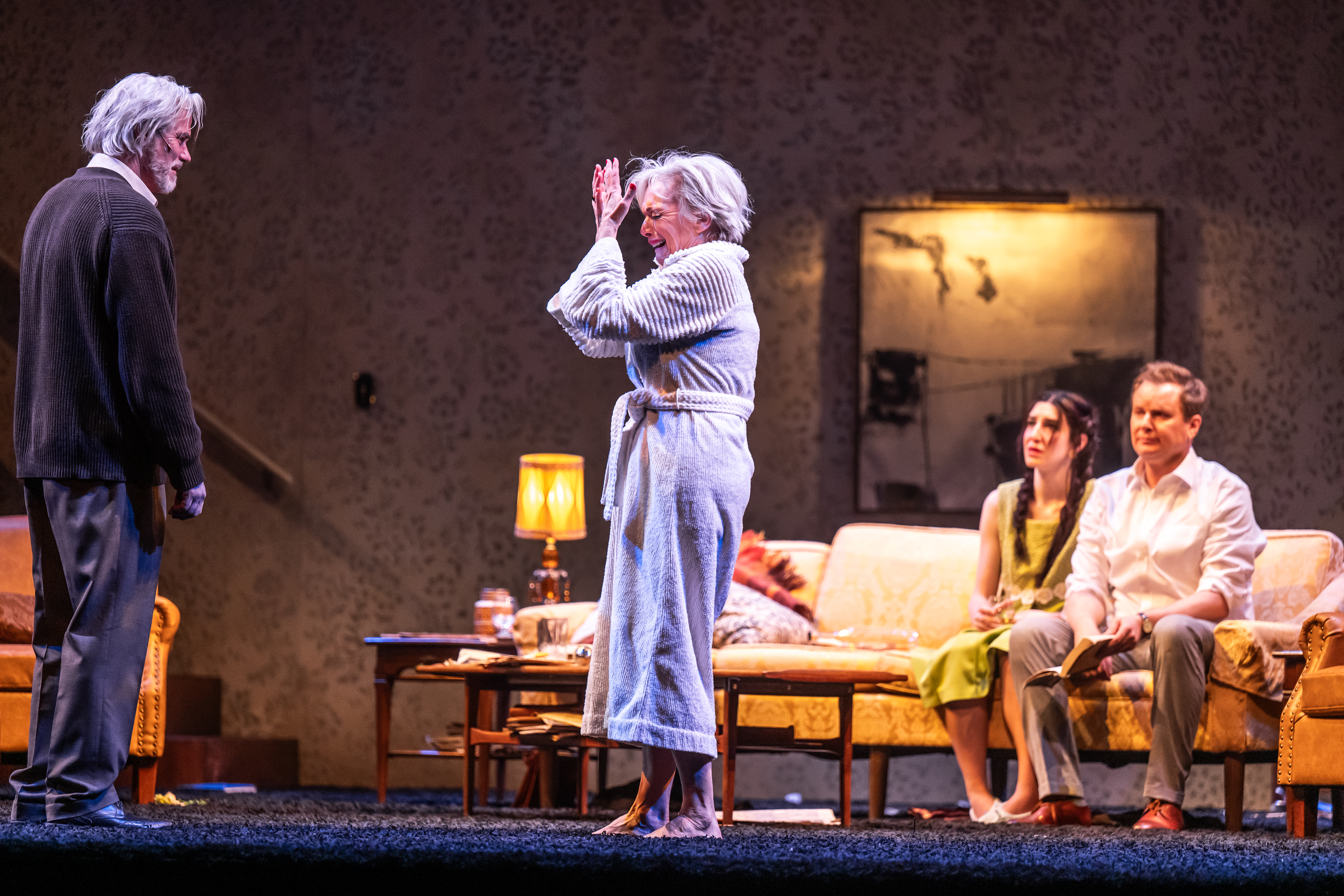
Photo by Dahlia Katz
“Who’s afraid of Virginia Woolf…”
“I…am…George…I…am…”
In these final moments in the play, where the layers of humour and deception have been stripped away lies the essence of Albee’s play: fear. Everything we’ve witnessed in the past three acts has been an attempt to exert power because without that what’s left? Fear of the loneliness and obscurity that haunts both George and Martha’s lives. Fear for Nick and Honey that they’ll one day become George and Martha. And so the bravado and bottle smashing and sexual advances and drinking are all there to cover up their fear. This production gives you such perfect glimpses at these vulnerable moments, and will leave an indelible mark on audience members.
Who’s Afraid of Virginia Woolf? is running at the Bluma Appel Theatre until February 16. For more information and tickets, visit: https://www.canadianstage.com/shows-events/season/virginia-wool
Cover Photo: Paul Gross (facing) with Rylan Wilkie, Hailey Gillis, and Martha Burns. Photo by Dahlia Katz.
Thank you to my Patrons:
N. Bushnik, S. Fisher, B. Kinnon, D. Moyes
And to my supporters who’ve bought me a coffee:
Angelica and Paul, Anonymous, Adrianna, and Caitlin
Would you like to become a Patron? Check out my Patreon at: https://www.patreon.com/AViewfromtheBox
Or, you can buy me a coffee at: buymeacoffee.com/aviewfromthebox
 A View from the Box
My wife & I travelled from the UK to see this and we weren’t disappointed by the performance. Martha Burns was amazing – the end scene was utterly crushing. The temptation, of course, was for Paul Gross’s George to match the ferocity of Martha, but he gave the perfect counter-balance to Burn’s amazing performance. We saw the first performance and Rylan Wilkie was brilliant considering how little time he had to prepare – bravo, Sir! All in all, well worth the trip across the pond!
LikeLiked by 1 person