What do you remember about 1999? I had turned 9 just days before New Year’s Eve, and the panic around Y2K was real. Adam Meisner’s For Both Resting and Breeding imagines a timeline where Y2K, or something like it, happened. For Both Resting and Breeding is an intriguing look at history, memory, and our tendency to glorify the past. Currently being staged in a posh west-end home, For Both Resting and Breeding is a beautiful reminder of who we are as human beings.
For Both Resting and Breeding offers a unique immersive experience as audiences attend the performance in a private residence. Upon entering, you’re asked to either remove your shoes, or put on little booties to cover the soles to preserve the flooring in the space. After divesting oneself of their coat, audience members are ushered into the kitchen/dining area of the home. The seating for the audience has been established on the dining side of the room, so that it faces the spacious kitchen island and cooking space. This kitchen is like something out of a magazine: the white cabinets are totally uniform, the marble of the island and counter matches those cabinets, the fridge and freezer and cleverly hidden within a large pillar of orange marble, and the cooking surface is totally flush with the countertop. The only thing that strikes is odd is how tiny the oven is, and yet that totally fits in with the style of kitchen. While there is only one bathroom available for use, the audience capacity is not so large as to make it a huge issue; what is huge is the bathroom itself (I now have bathroom goals to aspire to). The feel of the kitchen is perfect for how the characters in the play want to use it, and I’d give anything for a tour of the rest of this uniquely decorated home.

Photo by Dahlia Katz
Imagine a world where everyone uses ish as a pronoun, people are able to be created outside of the womb, and gender, and gender roles, no longer exist. Living in harmony with no real work to speak of and everyone provided for, it feels like Meisner has created a utopia. Yet these humans are intrigued by the past: the discovery of a true Millennial home in tact has a historian buzzing with excitement. The decision is made to make it into a museum of Millennial life, including having the characters play roles to portray a traditional household. They gather some volunteers and begin to attempt to recreate what a home in 1999 would have been like from the few artifacts they’ve been able to locate. However, delving into the past is beginning to threaten the tenants of their present, particularly when it comes to the outdated notions of love and breeding.

Photo by Dahlia Katz
Laura Delchiaro’s costume design for this production is astounding. The costumes the characters predominately wear throughout the play exemplify their beige life experience: natural tones of browns, greens, and navy blues comprise the jumpsuits they don. These are in direct and stark contrast to the vibrant clothes they wear as they portray the Millenial family. Oversized Addidas hoodies, a plain suit jacket with a tie I swear my father owned, and multiple shirts with a shrug on top are so perfectly 1999 it made me laugh. Even the details of the blinged out back jean pockets or grandma wearing multiple costume jewelry necklaces, it all fit so perfectly. It’s a wild experience having your childhood, which you can still vividly recall, being played out as a piece of history.
As the characters explain what their world is like, it’s difficult not to long for a similar society for ourselves; it sounds so peaceful and everyone is cared for and the inequalities which plague our current lives seem to have been sorted out. Yet by looking at the past, and at how we live(d), some of the characters feel like they’d like to break from their current norm. Ish20 says that she wants to feel pretty like a girl or woman, Ish40 seems to have no trouble slipping into the role of the father. Yet Ish84 decides that they want to take role of the grandmother, despite being male-presenting. We see how in some ways they long for the feeling and experience of our current gender norms, and yet there’s still the ability and excitement to look beyond those as well. This is in direct counter-argument to those that say that our current means of gender expressions is new: it has always been thus and it will ever be thus.
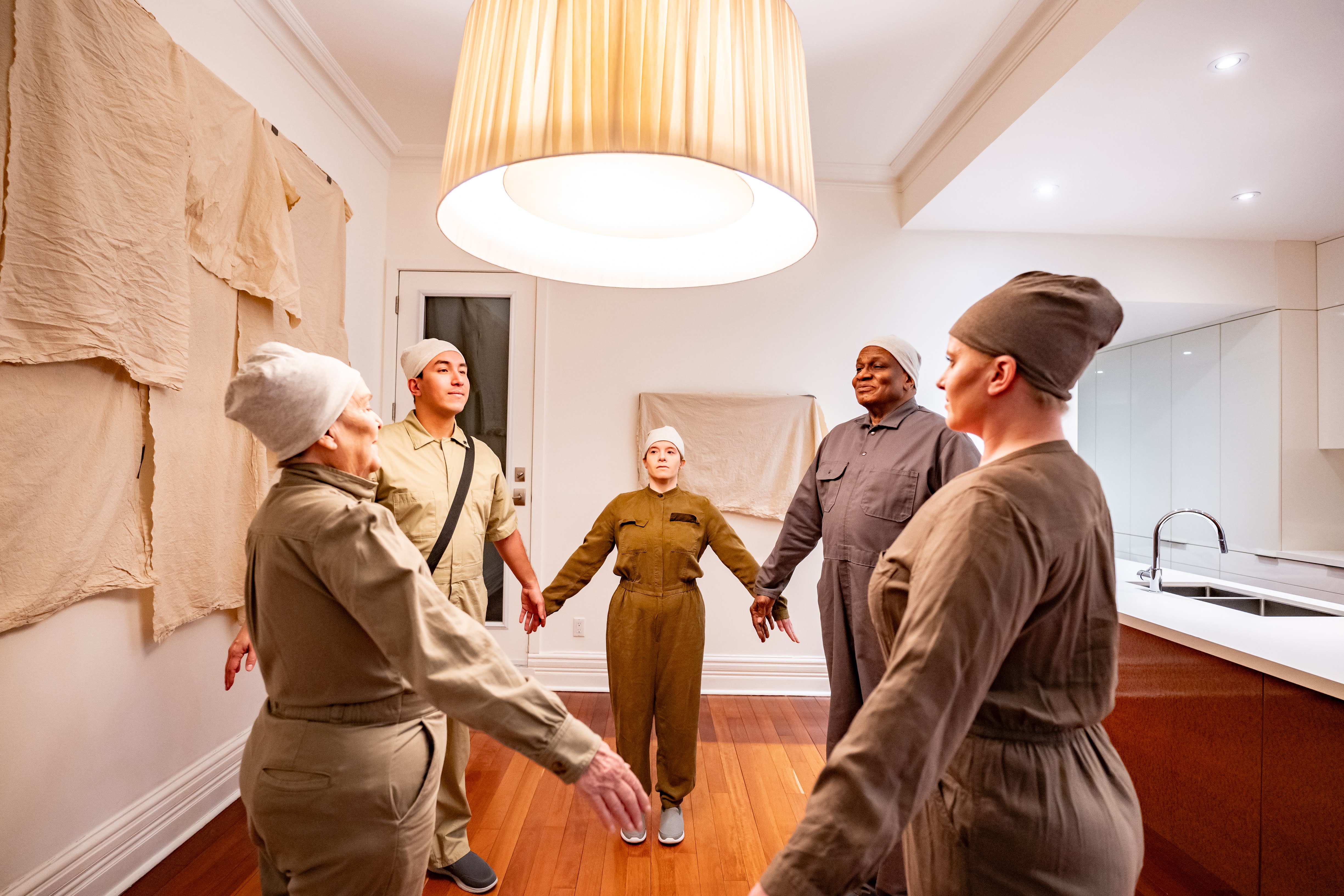
Photo by Dahlia Katz
However, at the core of For Both Resting and Breeding is the idea of connection and community. We find out through the characters that they live in little single-person dwellings, and without the need for breeding, there’s no need for dating or relationships. So this time that they spend together is exciting, as it’s not part of their typical every day lives. One thing that struck me immediately is how they greet each other: they look at the person who’s entered the room and raise their arms from their sides slightly while they take a nice deep breath. This acknowledgement of the other person’s being there and the way it feels like they’re making space for the other person is beautiful. But then I got to wondering if they do so because sharing space with another being is rare, and therefore meaningful for them as well. When the idea of even friendship is brought up between Ish84 and Ish34, it at first seems like a wild idea, and yet they’re both thrilled by it at the same time. We all long for connection, no matter how far our society has progressed, and it’s that connection which we need to return to, particularly in times of struggle.

Photo by Dahlia Katz
Maja Ardal, director of For Resting and Breeding, also plays Ish62. Ardal brings a stern feistiness to Ish62, and yet there’s a sense that she’s actually rather frightened of what could come from their experiment. Richard Lam plays Ish40, the historian who’s aiding Ish62 in setting up the museum. There’s an honesty and earnestness to Lam’s character which makes them immediately endearing; yet this is also what makes their actions at the peak of the play all the more heartbreaking. Jamie McRoberts’ Ish20 is curious and emotional in a most beautiful way. Her physical comedy is beyond funny, making her impossible to take your eyes off of. Amy Keating is Ish34: a nervous but willing to work engineer. Keating’s natural sense of comedic timing and vibrant energy make them perfect for this role. Alexander Thomas rounds out the cast as Ish84. Thomas has a commanding presence on stage, and his character was someone who I, like Ish34, immediately wanted to be friends with!
For Both Resting and Breeding brings up notions of individuality, pleasure, gender, and connection in a way that asks the audience to consider them from several angles. While there are many aspects of the lives that the Ishs live which we absolutely need to strive for, this play asks at what cost? Is there a way to ensure that we can all be sustained, equal, and still keep our personalities and ideas of who we are? Personally, that utopia is the one I’m fighting for: one where everyone can live in harmony exactly as they are and how they want to be. I think the Ishs would be pretty happy too.
For Both Resting and Breeding is running at 164 Cowan Avenue until January 31. For more information and details, visit: https://www.tift.ca/shows/for-both-resting-and-breeding
Cover Photo: Maja Ardal, Jamie McRoberts, Alexander Thomas, Richard Lam, Amy Keating. Photo by Dahlia Katz.
Check out my interview with Talk Is Free Theatre’s Artistic Director Arkady Spivak here: https://aviewfromthebox.net/a-view-from-the-box-the-podcast/
Thank you to my Patrons:
N. Bushnik, S. Fisher, B. Kinnon, D. Moyes
And to my supporters who’ve bought me a coffee:
Angelica and Paul, Anonymous, Adrianna, and Caitlin
Would you like to become a Patron? Check out my Patreon at: https://www.patreon.com/AViewfromtheBox
Or, you can buy me a coffee at: buymeacoffee.com/aviewfromthebox
 A View from the Box