“You only have one story” and Lucy Barton is ready to tell hers. My Name is Lucy Barton, written by Elizabeth Strout and adapted for the stage by Rona Munro, is a harrowing tale of Lucy’s fight for her life, both as a child and as an adult spending nine weeks in the hospital. Maev Beaty brilliantly brings Lucy Barton, and her mother, to life in this unmissable solo show.

Photo by Dahlia Katz
My Name is Lucy Barton predominantly takes place in a hospital in Manhattan, with a view of the Chrysler Building. Lucy has had a sustained fever after an operation, and has remained at the hospital for quite some time. One morning, she wakes up to her estranged mother at the foot of her bed. Having not seen each other for many years, the two begin to tell stories; mostly stories about the people they both knew back in Illinois, not so much about themselves. These stories flood Lucy with memories of an impoverished and difficult childhood, yet these glimpse’s into Lucy’s past heavily inform the woman telling the story.

Photo by Dahlia Katz
Maev Beaty’s performance is exceptional in every way. She brings a vulnerability and earnestness which suits Lucy Barton perfectly; the passion for storytelling which both actor and character share shines through every moment. The mid-west accents which she gives to the characters are spot on (guided by the work of voice and dialect coach Jane Gooderham); particularly her mother’s gravelly voice and heavy accent is immediately recognizable. Beaty’s whole physicality changes from one character to the next, never leaving us wondering whose part of the story we’re experiencing. Beaty is a captivating storyteller; the time flies by as the audience hangs on her every word.
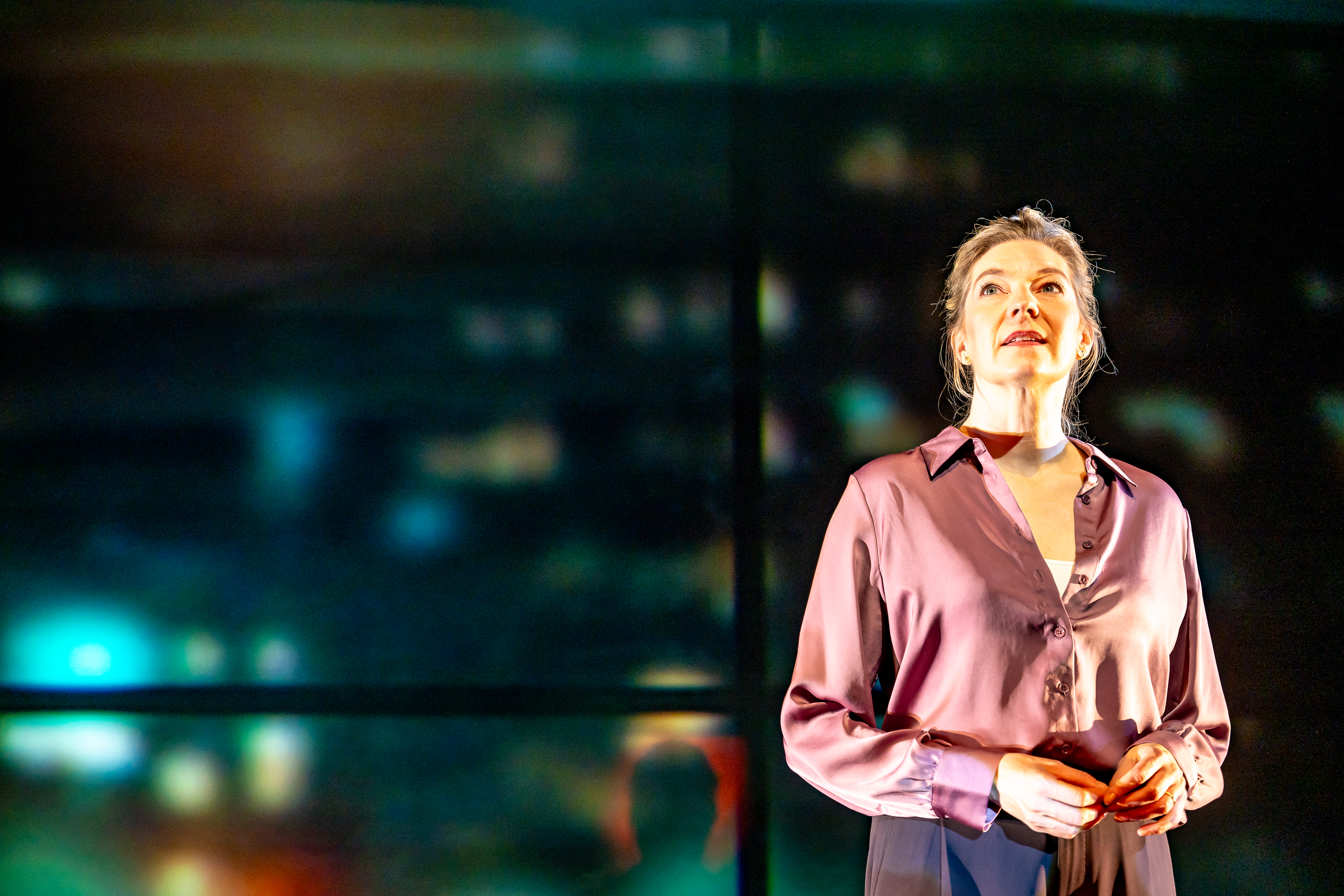
Photo by Dahlia Katz
Michael Gianfrancesco’s set design is perfect in its simplicity: because the actual moment in which we find Lucy is in the hospital, the bed and chair are all that’s required. The costume design is likewise elegant, the beautiful magenta looking stunning on Beaty. What transports us from place to place is Amelia Scott’s projection design. The fluidity with which these projections change shape and colour is mind-boggling, and the fact that we don’t ever truly have a sharp image, they’re all slightly fuzzy is perfection. My Name is Lucy Barton is a story of stories and memory, neither of which retain the sharpness of reality and get more unclear as time goes on. This theme is so clearly reflected in the projection and makes the experience feel like a dream in and of itself.

Photo by Dahlia Katz
Strout’s story does not shy away from the difficulties of life, and in that there’s a sense of honesty which echoes throughout the piece. Certain things like childhood trauma and self-actualization allow us all to see ourselves in Lucy. Yet Strout includes the poverty of rural America, the AIDS crisis (particularly in New York), and the trauma experienced by generations of soldiers coming back from World War II and Vietnam as well. It provides a sense of time and place, but also a greater understanding of the world and the challenges in which Lucy Barton exists.
My Name is Lucy Barton is a moving, gripping, and inspiring play about how our personal stories can dramatically change. We might have just one story, but one that is filled with life’s unexpected twists and turns, making it more of an epic than a bit of gossip told at the foot of a hospital bed.
For more information and tickets, visit: https://www.canadianstage.com/shows-events/season/lucy-barton
Cover Photo: Maev Beaty. Photo by Dahlia Katz
Thank you to my Patrons:
N. Bushnik, B. Kinnon, D. Moyes
And to my supporters who’ve bought me a coffee:
Angelica and Paul, Anonymous, Adrianna, and Caitlin
Would you like to become a Patron? Check out my Patreon at: https://www.patreon.com/AViewfromtheBox
Or, you can buy me a coffee at: buymeacoffee.com/aviewfromthebox
 A View from the Box