The last residential school in Canada closed in 1996; I started first grade that September, with no clue at all that these schools existed. Like most young Canadians, I didn’t learn about the full extent of the atrocities perpetrated against Indigenous peoples until well into my adult life, and plays like Jani Lauzon and Kaitlin Riordan’s 1939 opened my eyes and my heart to our history. In a co-production with Belfry Theatre and in association with the Stratford Festival, the Canadian Stage production of 1939 exquisitely highlights the attempted erasure of Indigenous culture through residential schools while also delivering a heartwarming story about five friends whose lives are changed through the beauty of theatre.
1939 takes place at a residential school in Northern Ontario, where news of a visit from King George VI and Queen Elizabeth has begun to cause quite a stir. Guided by their passionate English teacher Miss Ap Dafydd (delightfully portrayed by Catherine Fitch) and enthusiastic hockey coach Father Williams (a likewise hilarious portrayal by Nathan Howe), five students are selected to give a presentation of William Shakespeare’s “All’s Well that Ends Well” for their monarchs. Thanks to the help of a reporter Ms. Macbeth (played with great moxie by Amanda Lisman), they play to a sold-out house!
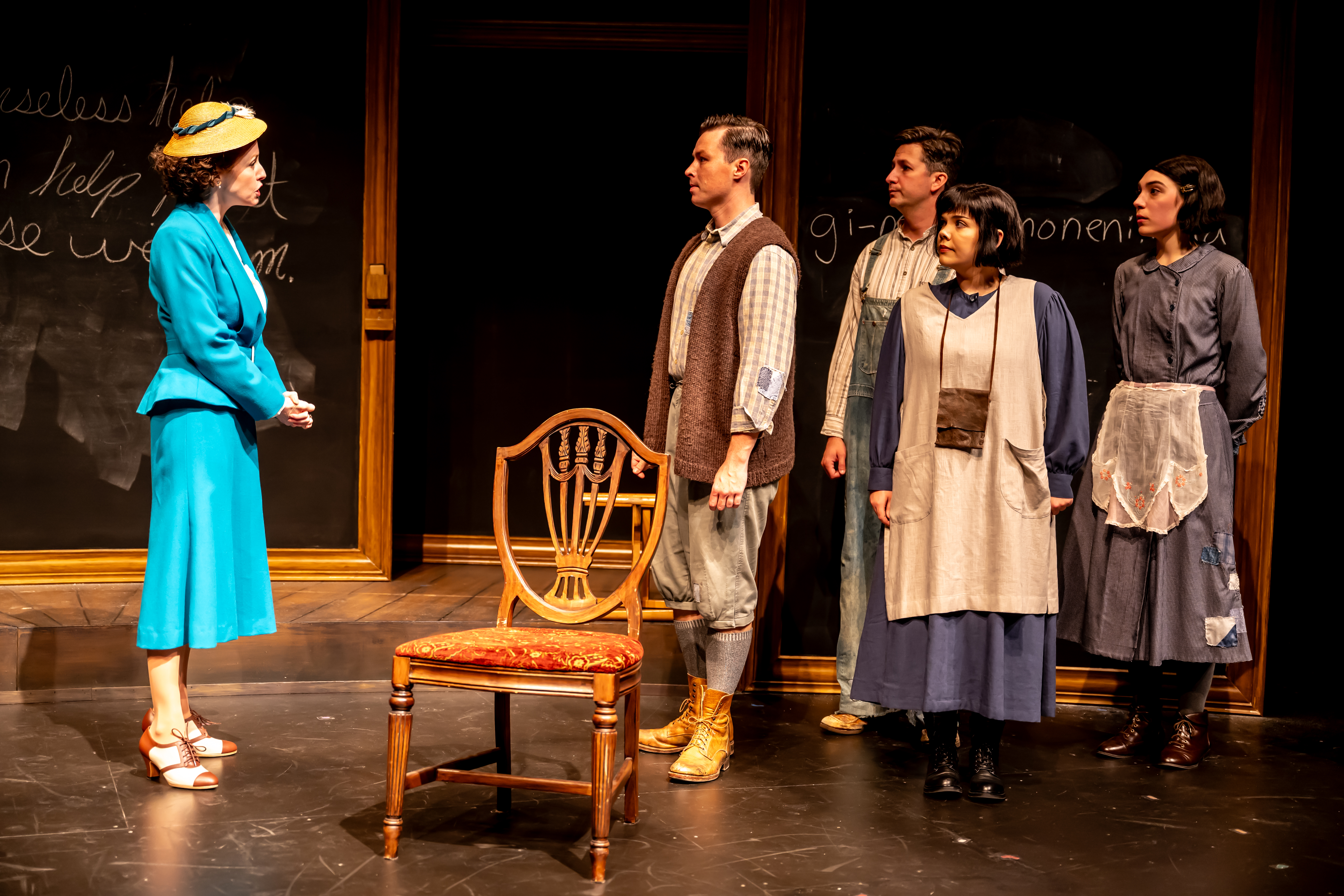
Photo by Dahlia Katz
Brefny Caribou (Susan Blackbird), Merewyn Comeau (Evelyne Rice), Richard Comeau (Joseph Summers), Grace Lamarche (Beth Summers), and John Wamsley (Jean Delorme) portray the Indigenous students. They represent Cree, Mohawk, Ojibwe, and Métis peoples, using their languages, songs, and traditions throughout the play. Their performances are a combination of strength and vulnerability: strength in being able to tell the stories of their ancestors, and the vulnerability to allow the audience into that experience through this work. There are also many moments of levity and joy, and those moments are given the same sparks of passion as the more serious notes of the production. The cast of 1939 truly give their all to this play, and their care, grace, and understanding are felt from beginning to end.

Photo by Dahlia Katz
Throughout 1939, the children speak about the fear and mistreatment they face every day. Everything from having their hair cut upon arrival to having it shaved off again as a punishment, forced child marriages to being denied meals; some things are only spoken of while others are directly depicted on stage. Most moving is when they name the friends they have lost during their time there, a pointed reminder of the horrors these particular children were luckily spared but so many others faced in reality.

Photo by Dahlia Katz
However, the cultural erasure of Indigenous peoples which was perpetuated in these schools becomes the visual focal point of 1939. Three giant blackboards make up the background of Joanna Yu’s set design. Used by student and teacher alike, they become physical representation of the cultural erasure the students face. The nuance and meaning put into each drawing and eventual expunging is fascinating to witness. For example, the students rarely wipe each other’s work off the chalkboards, unless it’s a Shakespearean quote. Those Shakespearean quotes are also exclusively written by Beth, showing her passion for the Bard as well as learning. Joseph shows his concern for the loss of his language by only writing down Anishinaabemowin words, while Evelyne shows her family’s history in medicine by drawing different herbs and plants. Jean writes to his mother, an sign of their deep connection. Yet time after time these words and pictures are wiped away, more frequently by Father Williams than Miss Ap Dafydd.
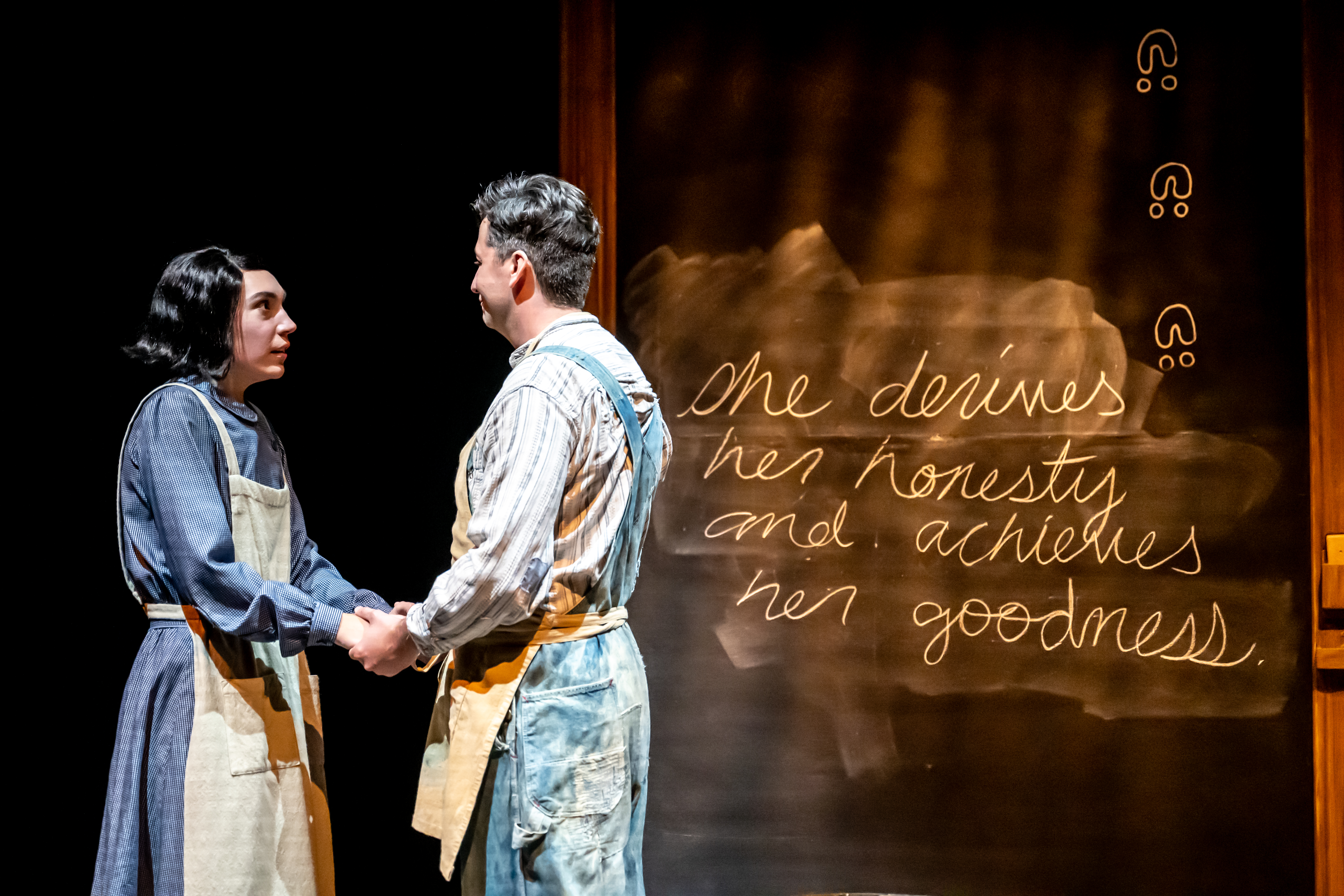
Photo by Dahlia Katz
A highlight of the production are the emblems which they cannot erase, the ones at the top of the blackboards which appear one by one as the students begin to embrace and display their heritage through their acting. Appearing as if by magic, these symbols of caribou tracks and antlers, the sun, and even Turtle Island itself cannot be wiped from the blackboards, no matter how hard Father Williams tries. These lasting symbols of their culture are beacons of hope and perseverance; proof that the sprit of Indigenous communities has never been snuffed out and will not be in the future.
The renditions of “The Maple Leaf Forever” which are used in this production are haunting; at first sung by a small child, then adjusted as we come back from intermission to reflect the experience of the students we’re witnessing, then brought back again as Beth remains at the school after the graduation of her peers. 1939 successfully interrogates many of the notions of Canadian culture which we feel we know so intimately as Canadians, right down to the song which used to be our unofficial national anthem. Every Canadian needs to see 1939.
For more information and tickets, visit: https://www.canadianstage.com/shows-events/season/1939
Cover Photo: L-R: Richard Comeau, Merewyn Comeau, Brefny Caribou, Nathan Howe, John Wamsley, Grace Lamarche, Catherine Fitch. Photo by Dahlia Katz.
Thank you to my Patrons:
N. Bushnik, B. Kinnon, D. Moyes
And to my supporters who’ve bought me a coffee:
Angelica and Paul, Anonymous, Adrianna, and Caitlin
Would you like to become a Patron? Check out my Patreon at: https://www.patreon.com/AViewfromtheBox
Or, you can buy me a coffee at: buymeacoffee.com/aviewfromthebox
 A View from the Box