“They paved paradise and put up a parking lot” Joni Mitchell’s 1970 hit continues to ring true in a society where urban sprawl and diminishing green space remain a perpetual issue. Yet Annie Massey’s new play Pave Paradise takes this idea a step further to debates about what should be done with, and who should be allowed to live on, the parking lots we’ve created. In an outdoor presentation directed by Pat McCarthy, Pave Paradise has a lot to say, and could go even further with saying it.
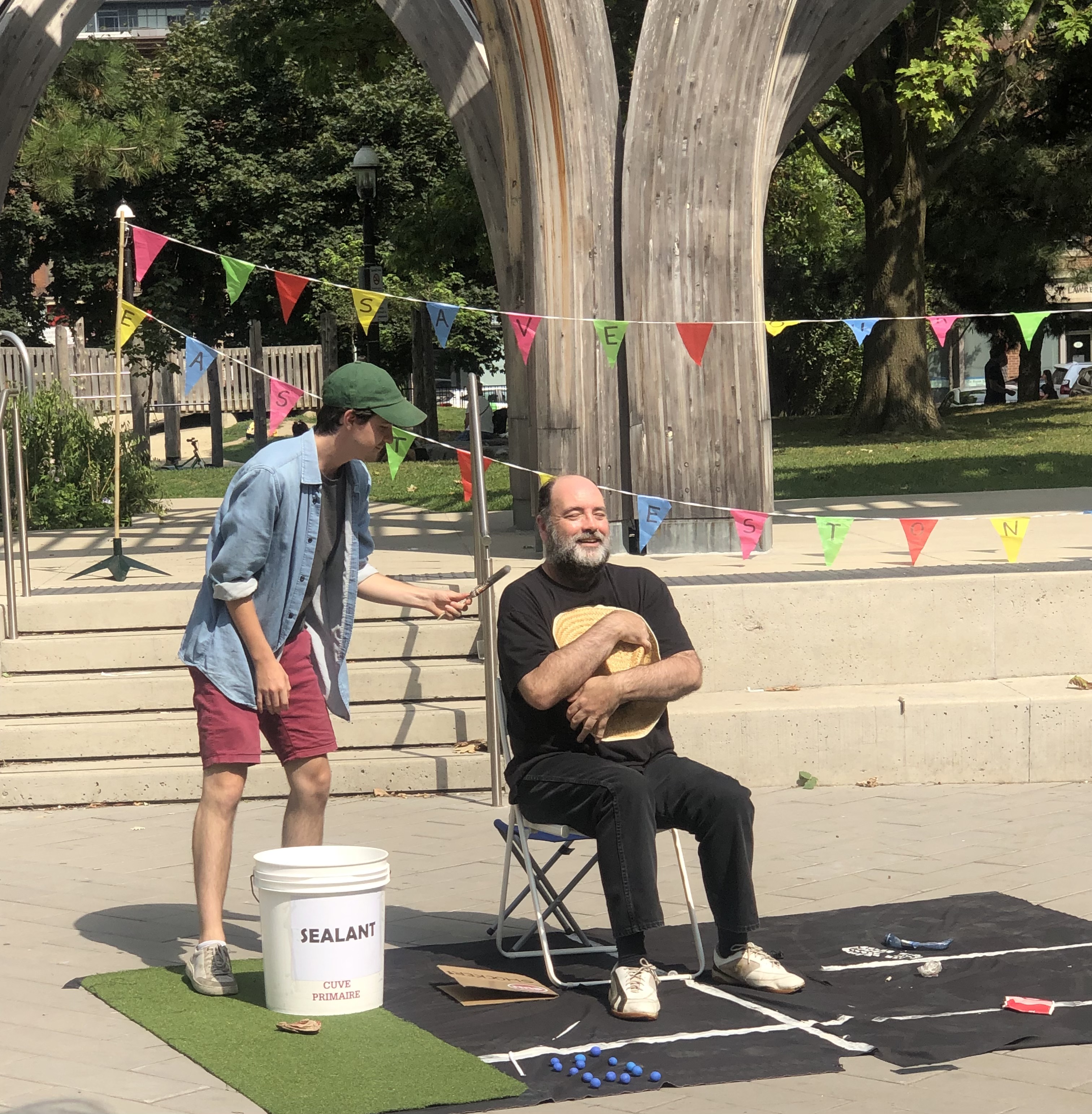
Photo by Paul Bilodeau
Pave Paradise was performed in St. James Park along King Street, which actually speaks to the heart of the show. Because people can simply come upon the show, not knowing it was going to be there, stop, listen, and appreciate art, all for a pay-what-you-wish price is very much in line with the utopic vision that Pave Paradise’s younger characters have. Of course, outdoor theatre always has its challenges: people walking right through the stage area while the performance is happening, the bells of the church tolling every 15 minutes, and the perpetual noise of a city. While this adds some charm and verisimilitude for a play which is taking place on a parking lot, it also made it so that the actors were often difficult to hear, even if you were sitting close to the action. I found that there were a few times where the character had their head turned, or moved to the very back of the playing space, or simply mumbled a bit and I lost a whole chunk of what was being said. Really, it made me hopeful to get to see this as a staged indoor production, so that I can get the full sense of the dialogue.
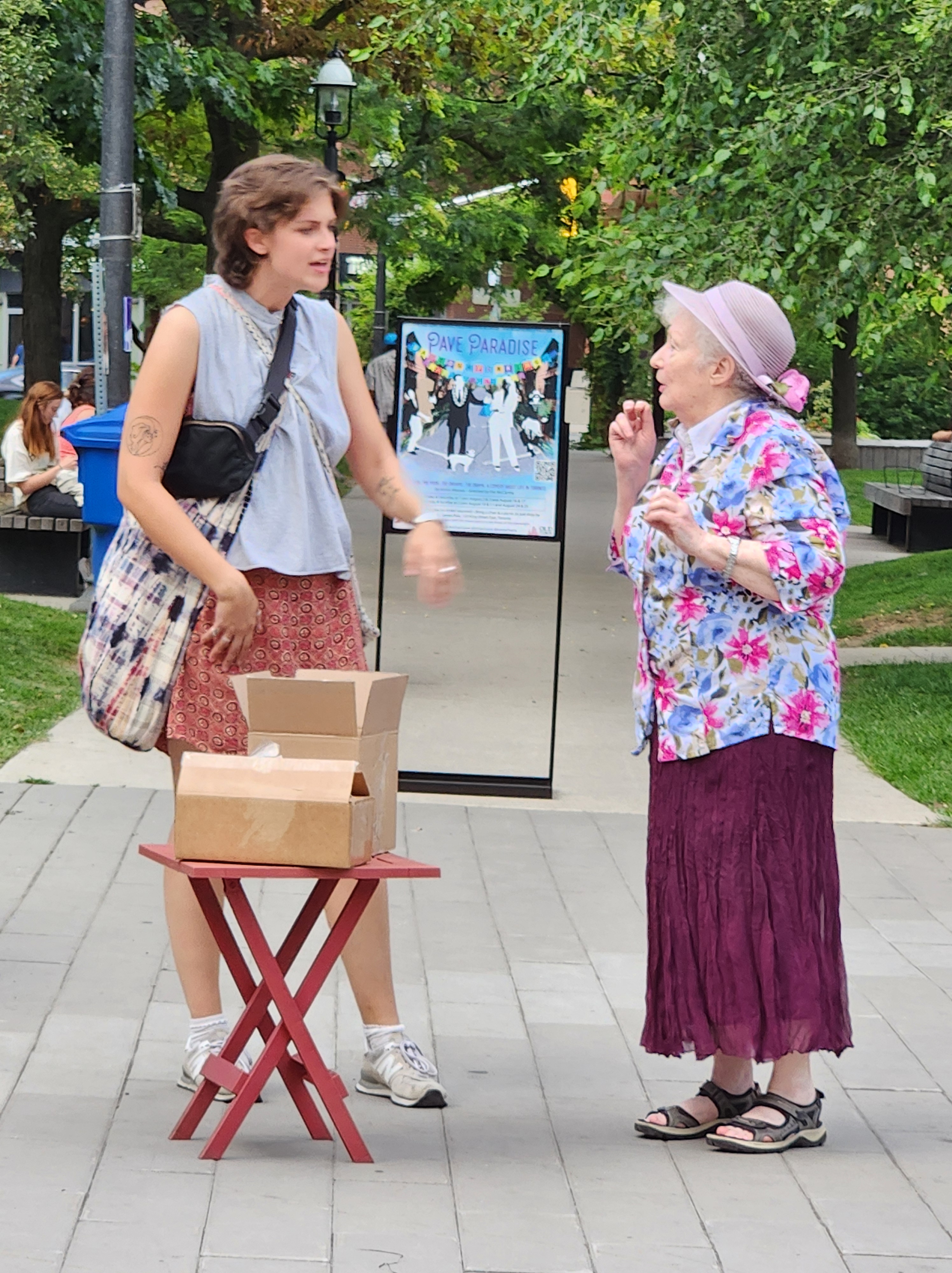
Photo by Paul Bilodeau
Pave Paradise focuses on Toronto’s housing crisis but in a unique way. In this case, the citizens of a semi-affluent neighbourhood are dismayed when they hear that the city is planning to build a set of modular homes on a parking lot which they claim is the “beating heart” of their community. They don’t want ‘those kind’ of people living in their neighbourhood. They begin to campaign the city to stop the development of the modular housing on their beloved parking lot, eventually with success after meeting the mayor in person. All the while, there are two younger residents of the neighbourhood, one who is unhoused and one who has trouble keeping up with her rent, who use the neighbourhood to their advantage; they’re inventive with their ‘procurement’ of items and how they make money from their more elite neighbours. The dichotomy is stark, and noted throughout the play, the only character unifying them is Mac, the parking lot himself, which everyone uses.
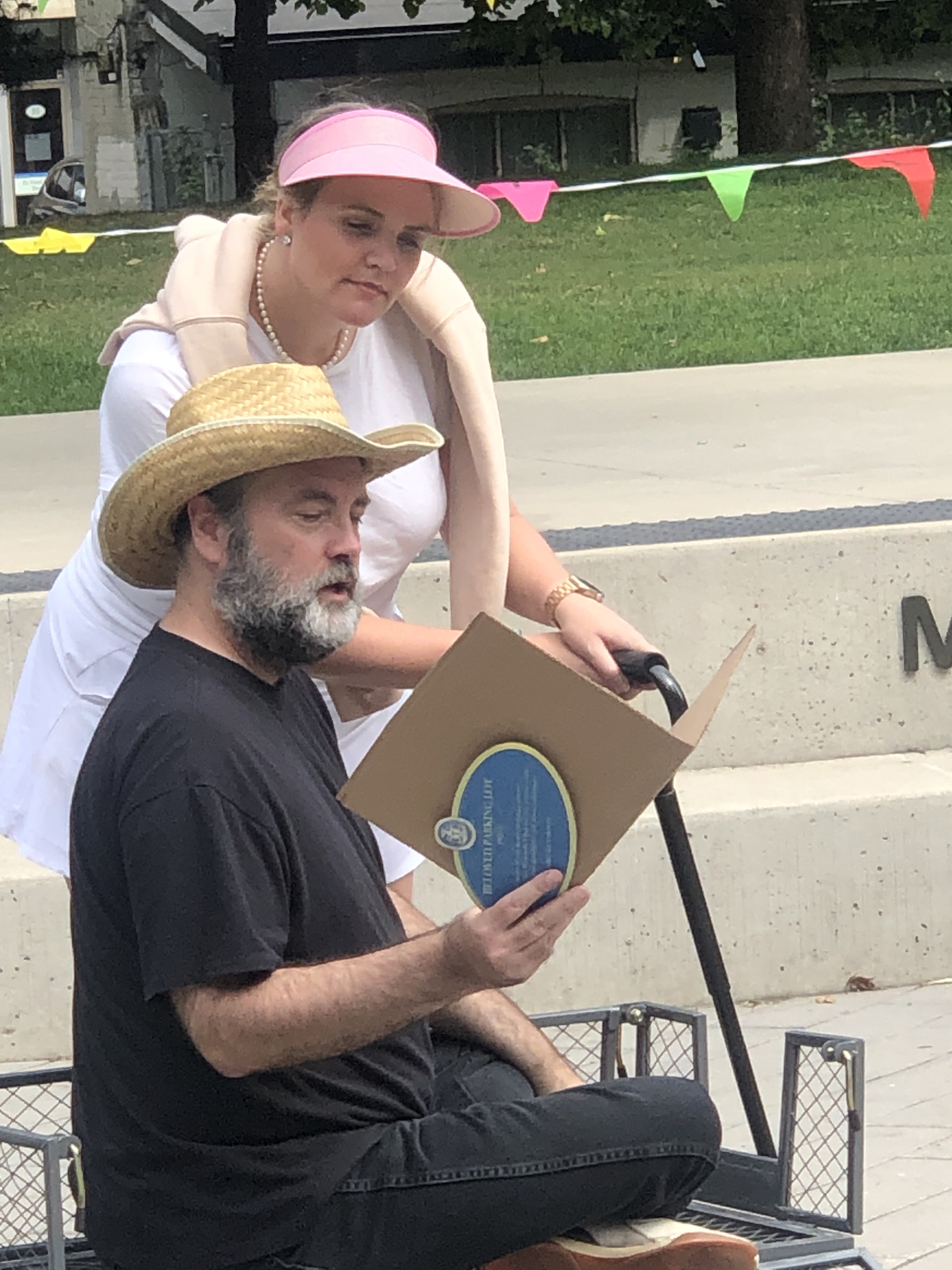
Photo by Paul Bilodeau
Massey’s text feels almost allegorical in nature, using names like Fairly-Affluent, Mr. Shady, and Mayor Wibble for some of the main characters. I think my main issue with the text was that I didn’t feel like anyone learned their lesson, except Mac, yet Mac has been the more open minded one from the start. Mac likes Pete, who lives in a tent on his outskirts and who chats with him every day. And while initially Mac doesn’t like the idea of being ripped up to build housing, he comes around by the end because he’s witnessed Pete’s plight to find a home. While Pete and Anthea end up moving in together and therefore finding stability, it’s in a neighbourhood where they know they’re not wanted and likely won’t be sustainable to live there. When Norma Fairly-Affluent is confronted at the end of the play by the fact that Pete has not only been stealing her packages, but has also been living in the parking lot, she doesn’t really say anything, and so I can’t get a feel for whether or not she’s learned that she’s painting everyone with a broad brush or not. I couldn’t get the feeling that she’d changed enough over the course of the play to actually make it a happy ending.
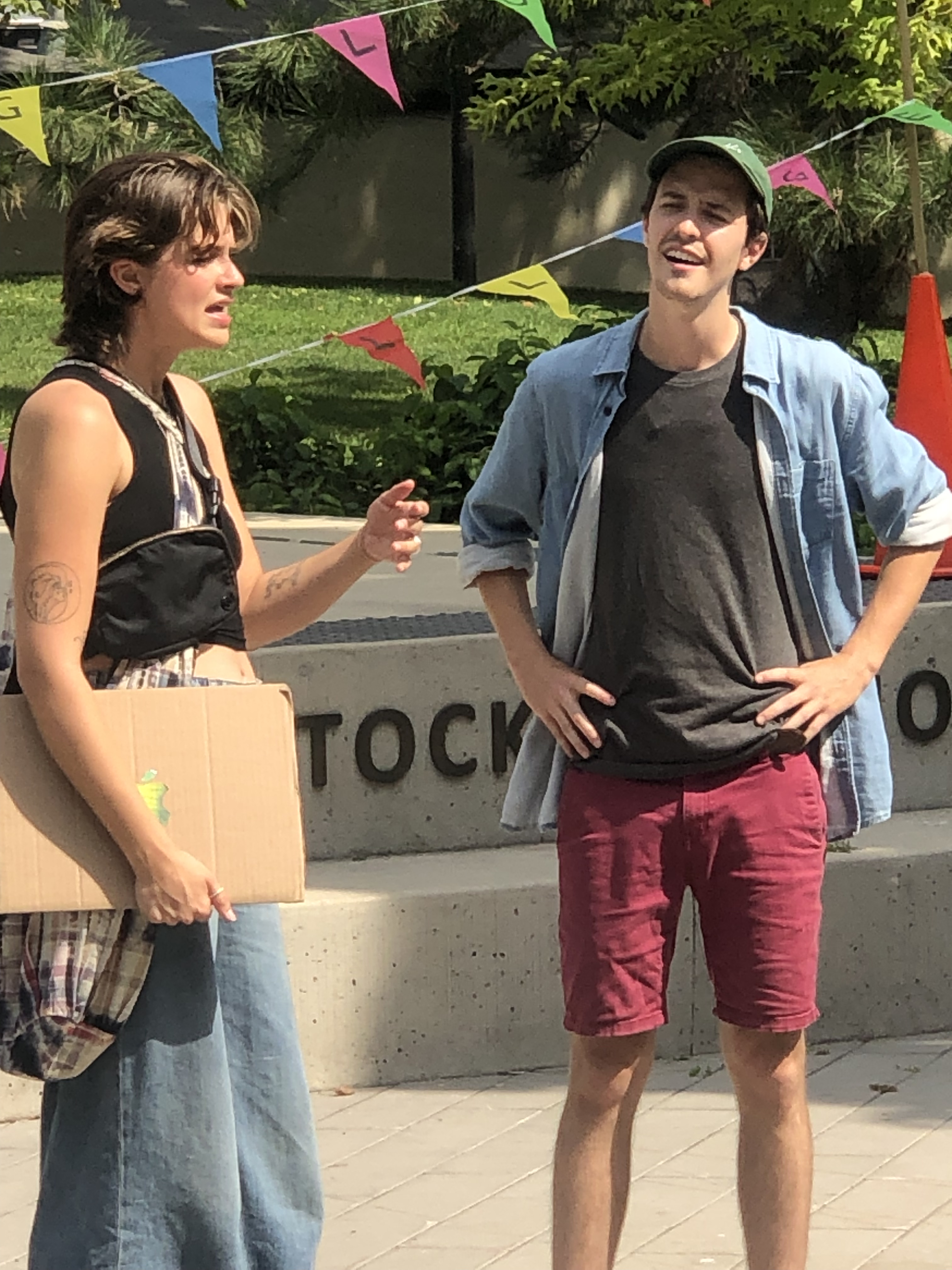
Photo by Paul Bilodeau
I was also mildly shocked at the mention of sex toys so much throughout this play; like very direct mentions of dildos and sex toys, particularly in regards to Pete stealing them from people’s porches. It was just such a random thing to fixate on and yet there’s no warning about their being adult content. This was also being performed outdoors, where anyone of any age was able to hear, so maybe it would have been better to have changed the items to something a little more family-friendly for a park performance which has a playground about 15 feet away from the stage.
That being said, I was impressed to see a message about the need for more housing and the compulsion for younger generations to make money however they can come from an older author. The text was also very direct about how Pete came to be in his position, and how the system doesn’t work for people without a fixed address. Hopefully it’s the sign of better things to come, and the possibility that someone like Norma Fairly-Affluent can learn to love her neighbours, no mater what their tax bracket.

Photo by Paul Bilodeau
David Borwick’s Mac is as smooth as his namesake, and as I’ve mentioned previously, shows the most growth throughout the play. Borwick is charming, kind, and has a funny story about everyone in the neighbourhood. Paula Wilkie plays Norma Fairly-Affluent, and you can tell how much fun she was having embodying this well-to-do lady with her hilariously named dog. Andy King’s Mr Shady and Mayor Wibble were suitably played according to their name’s implications, and he has a great stage presence. Melody Schaal’s character had the most white suburban lady name of all: Muffy. Schaal was clearly living Muffy’s full fantasy, complete with a sweatshirt worn only around her shoulders and a pink glittery visor; she was comedic perfection. Adrian Chevalier and Makenzie Hay were the shining stars of the production as Pete and Anthea. Their love story was a nice undercurrent to the production and the two had great chemistry. Chevalier’s performance had a genuine and compassionate quality which put you on his side immediately. Hay is a sweet and driven Anthea, I loved her moxie!
Pave Paradise certainly has potential; I think the message could use a bit of tightening up, and a solid resolution considering the subject matter, and then it would be great. I hope that this will have more lives and more iterations to come. To keep up with Alumnae Theatre and their new season, check out: https://alumnaetheatre.com
Cover Photo: Andy King as the FedUp truck driver, Adrian Chevalier as Pete, and Melody Schaal as Muffy. Photo by Paul Bilodeau
Thank you to my Patrons:
B. Kinnon, D. Moyes
And to my supporters who’ve bought me a coffee:
Angelica and Paul, Anonymous, Adrianna, and Caitlin
Would you like to become a Patron? Check out my Patreon at: https://www.patreon.com/AViewfromtheBox
Or, you can buy me a coffee at: buymeacoffee.com/aviewfromthebox
 A View from the Box