1S1 Theatre is making it’s mark in the Toronto Theatre scene with their innovative and thought-provoking productions centred around audism and the lives experienced by those in the deaf/Deaf community. Dawn Jani Birley, 1S1’s Artistic Director will be taking to the stage again this fall in Qalb, A Journey of the Ego. I got to ask Dawn about the show, the collaboration which went into its creation, and what’s to come from 1S1.
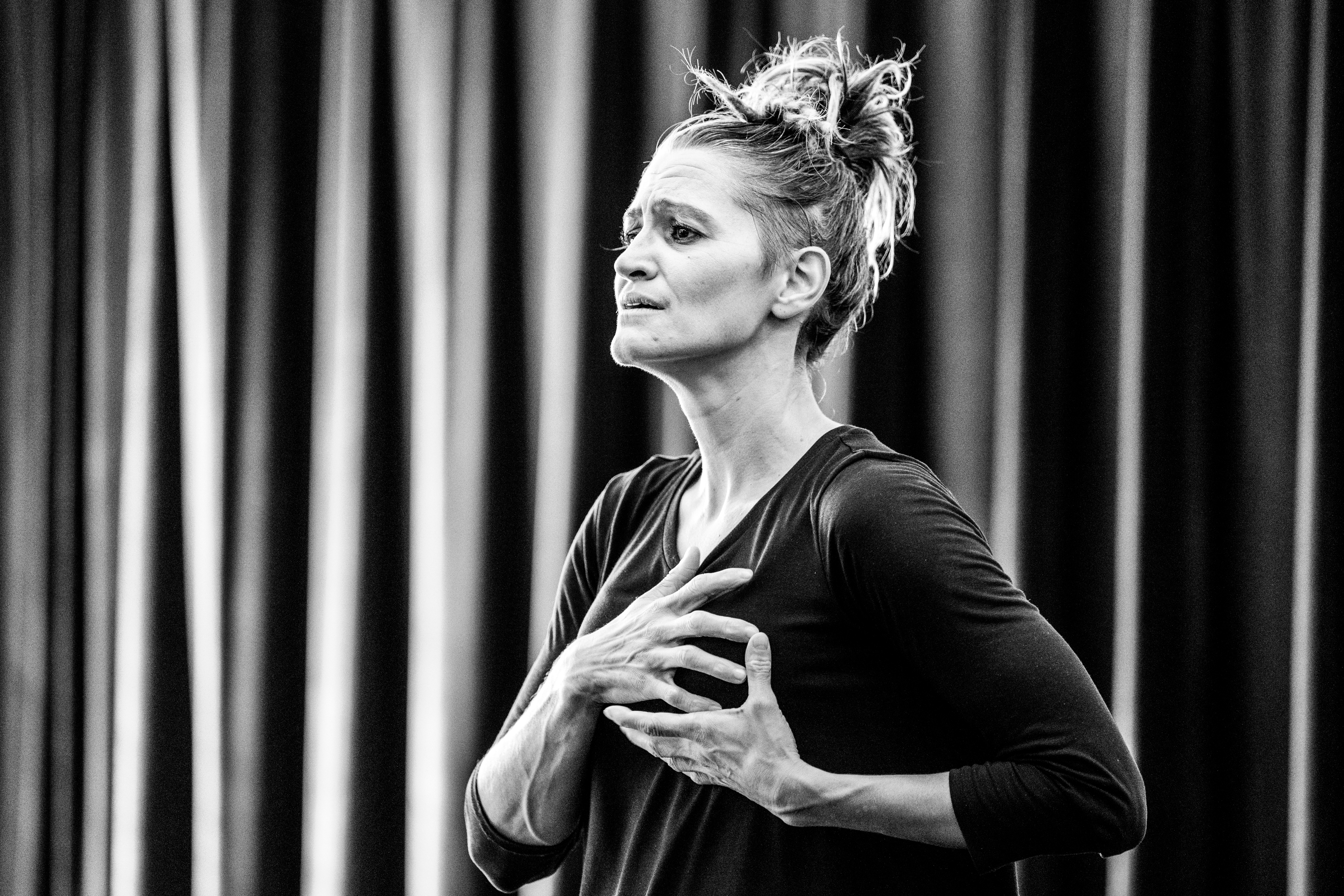
Photo by Dahlia Katz
- Could you please introduce yourself to my readers and talk a bit about your role with Qalb, A Journey of the Ego?
Hi, I’m Dawn Jani Birley, Artistic Director of 1S1 Theatre. I was born in Saskatewan into a third generation Deaf family and I identify as culturally and linguistically Deaf. Lady M (Margaret), our inaugural production, took place last year, and we are currently staging our second production, Qalb, A Journey of the Ego. This play talks about the struggle between the mind (Ego) and the heart (Qalb). I am playing the role of Qalb opposite Deb’e Taylor who plays Ego.
2. I loved Lady M and your interpretation of both the character and the play. Is there another Shakespearean character or story you’re looking to explore?
Currently I am not working on any Shakespearan pieces, however I am always interested in exploring Shakespeare’s works and I’m sure I will tackle that again when the opportunity arises.
3. What about Rumi’s works inspired you to write Qalb, A Journey of the Ego?
I have long admired Rumi’s works and teachings and wanted to bring that wisdom to life in a unique, visual way. Qalb, a word borrowed from Arabic, means heart in Rumi’s native Persian language. Diving into his world of thoughts and poetry, this story is about heart and resilience. Inspired by my life as a Deaf person facing audism, my human story relates to all dealing with oppression. I turn to the philosophy of Rumi to transform our oppression, anger, and frustration into a force of love in the world. Ultimately, we do not see things as they are, we see them as we are. Rumi often conveys themes of love, unity, and spiritual enlightenment. He encourages looking beyond the material world and connecting with the divine or inner self. His poetry often speaks about the transformative power of love and the importance of embracing all experiences as part of a greater spiritual journey. In short, Rumi urges us to seek a deeper understanding of ourselves and the universe through love and spiritual awakening. In today’s world, which is full of hate, fear, marginalization, and injustice, Rumi’s words stand out as teachings to guide us and I believe this is a critical time to share this message.

Photo by Dahlia Katz
4. You’ve collaborated with artist for all over the world to create this piece. What was that process like?
1S1 Theatre’s vision is a simple one, we want to have both Deaf and non deaf people, signers and non signers, come to the same space to enjoy theatre together. Making that vision a reality however, is anything but simple. Historically there has been theatre that is geared towards audiences who can hear, and theatre that targets Deaf audiences, but my goal is create theatre that all audiences can enjoy. I do this by looking for the intersection of the Deaf and Hearing worlds; I’m looking at where these worlds overlap. Every story that we tell is told through a new and unique theatrical language and it is dependent on what the story itself needs, and why that story is being told.
For this play, the timeless philosophy and poetry of Rumi, that has been translated into countless spoken languages, is being made visible, translated into American Sign Language, to allow Deaf and Hearing people to access these teachings in a new way. Like Shakespeare, Rumi’s verse is known globally, but many Deaf people have never heard of Rumi’s work because it has never been translated into a language that is fully accessible to them. In this production ASL poetry, which gained immense popularity in the 1980’s and 90’s, is front and center and is used as a means of expressing Rumi’s ageless work. Director Debbie Rennie is herself a renowned ASL poet and she brings her skill and creativity to this production, elevating the work through this medium. ASL poetry is a celebration of Deaf Culture and shows the richness, creativity and depth of a community that often communicates through visual language rather than spoken word.
To give you some context, in Canada the federal government doesn’t recognize American Sign Language (ASL), Langue des Signe Quebecoise (LSQ) or any indigenous sign languages as official languages of the country; these languages don’t have constitutional standing. That means that Deaf Canadians are not protected under that law and do not have legal rights to use their language. Without that protection we have no legal recourse and our very identity is in jeopardy; we lack the legal right to access services that are freely accessed by other Canadians. This production, by using sign language and ASL poetry as a medium for storytelling, builds a bridge that allows Deaf and Hearing people to come together in celebration of Deaf Culture and Deaf people’s language. The goal is to foster empathy of and appreciation for the Deaf life experience. Deaf people have a rich history, spanning hundreds of years, but our story is rarely told.
This process has been very collaborative as we have both Deaf and Hearing artists working together. Aspects of hearing and Deaf people’s life experiences are reflected in the play, but the real heart and essence of the work is Deaf led. We, as Deaf people, are here and we always have been. 1s1 is excited to offer a platform where we can bring Deaf stories to the stage.
5. Do you have any other upcoming projects that you’re excited about?
Absolutely, 1S1 definitely has other projects in the works. We will be showcasing our next production To A Flame which is an innovative re-imagining of Edgar Allan Poe’s The Fall of the House of Usher. Written by acclaimed Canadian playwright, Erin Shields and directed by Josette Bushell-Mingo, this piece explores themes of power, patriarchy, and historical erasure from the perspectives of three women—one Deaf, one Black, and one White. Set in the Gothic era, this dark and truthful narrative delves into their struggles against systemic oppression and isolation within a decaying mansion. The story is told through a rich tapestry of movement; Canadian American Sign Language (CASL); music; and visual projections. The piece invites audiences to witness the intersection of race, gender, and ability in a haunting, authentic way, which is at the forefront of societal change. To A Flame has been 10 years in the making and 1S1 will be staging it in the summer of 2025. We are excited to share this groundbreaking work with Toronto audiences.
I want to thank Dawn for taking the time out of her busy schedule to answer my questions. I’m really looking forward to seeing Qalb, which runs at Tarragon Theatre’s Extraspace from September 7 – 14. For more information and tickets, visit: https://tarragontheatre.com/plays/2024-2025/guest-presentations/qalb/
Thank you to my Patrons:
B. Kinnon, D. Moyes
And to my supporters who’ve bought me a coffee:
Angelica and Paul, Anonymous, Adrianna, and Caitlin
Would you like to become a Patron? Check out my Patreon at: https://www.patreon.com/AViewfromtheBox
Or, you can buy me a coffee at: buymeacoffee.com/aviewfromthebox
 A View from the Box