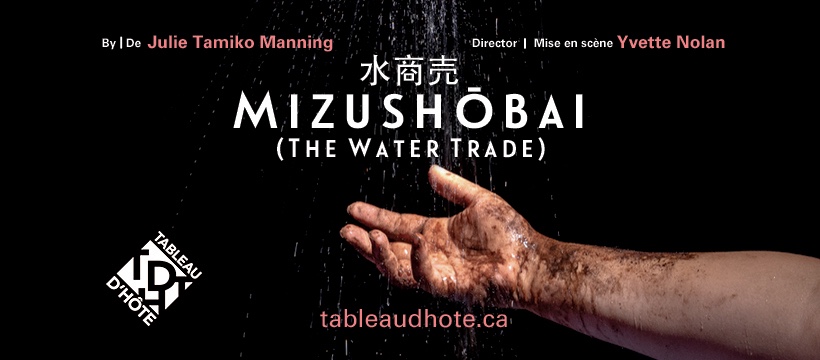
The Segal Centre in Montreal is currently hosting Mizushōbai (The Water Trade), the latest work from Julie Tamiko Manning. This incredible true story about a Japanese immigrant making her mark in Canadian Industry is sure to enthral audiences. I was fortunate to be able to ask Julie Tamiko Manning some questions about her process, the true story behind her play, and what she hopes is next for Asian-Canadian Theatre!
1.Could you please introduce yourself to my readers and tell us about your role with Mizushōbai (The Water Trade)?
My name is Julie Tamiko Manning and I am an actor, theatre creator and playwright from Tiohtiá:ke / Mooniyang / Montréal. I have been working in theatre for over 30 years and I have had the great opportunity to travel for work in places like Vancouver, Toronto, Ottawa, Barcelona, Nunavik, New York, Thunder Bay and Halifax. I started to write about 15 years ago, not because I had any burning desire to write but because I didn’t see myself or my community onstage. My first play, Mixie and the Halfbreeds, was co-written with Adrienne Wong, and it was the first time I had ever really explored my feelings around being mixed race. I remember looking out into the audience in Vancouver and seeing a sea of people who looked like me. That was a really wild experience. My second play, The Tashme Project: The Living Archives was a verbatim play created with Matt Miwa about our Japanese Canadian community’s wartime experiences. It was where I realized how healing the process of art-making could be. Matt and I set out to heal our community from the shame of Internment during WWII, and we ended up healing ourselves as well. Both of these plays were also performed by us, the creators. Mizushōbai- The Water Trade is my third play, however this time I wrote it solo, AND I have left the performing up to others. Which is quite freeing!
2. What drew you to this story in particular?
Kiyoko was an Issei (first generation immigrant) woman who exploded my idea of what Issei women were supposed to be like. The older Japanese Canadian women I knew, like my grandmother, were quiet, submissive and didn’t take up a lot of space, which I always had a hard time with as I was none of those things. I thought that my existence was wrong because I didn’t really display any of those qualities. Kiyoko’s existence seemed to fly in the face of those cultural and gender expectations. So I was immediately intrigued by her. I felt represented by her. But at the heart of it, this play came out of my anger and exhaustion around the fetishization of Asian women.
3. I read a synopsis of the play, and there appears to be a great struggle for the main character in terms of defying, but also at times reinforcing, the stereotypes around female Asian bodies. Could you please talk about that and what that struggle was like to write?
Much of my life has been spent thinking deeply about how Asian women are seen in society and the ceilings that exist for us around things like business, sexuality, power and artistic expression. In much of the media I found on Kiyoko, the headlines would usually scream “brothel owner”. I felt really sensitive about that- women who do sex work are often reduced to something titillating, illegal, derogatory- and their family, relationships, and feelings are never part of that image. The stereotypical image of Japanese women is that they are diminutive, submissive, quiet or they are reduced to a crude objectification of “geisha girl”. There is still such a toxic idea of what an Asian woman is in 2023- people still love to fetishize Asian women- which I just don’t understand.
I wanted people to know that Kiyoko was three dimensional, more than just a headline: she was a woman of power and intelligence AND she was also flawed. I think it’s really important to take the stereotype of the Asian woman down from the pedestal in order to demystify these societal fetishes and prejudices. I wanted to wrest the narrative of the Asian woman out of the hands of men and put it into the mouths of Japanese Canadian women. I wanted the audience to see 5 Japanese Canadian women of different generations, different body shapes, different histories, come together and tell the story of a woman who was a multitude of things at the same time. Kiyoko was a survivor AND a thriver.
4. In your research for the play, was there a certain story or fact which surprised you?
In all honesty, much of her life surprised me: the fact that she spoke about getting an STI from one of her many boyfriends that she had throughout her life, until she was 88; the fact that she resisted Internment and was sent to jail; the fact that she did not love her fellow Japanese Canadians- she preferred working and living with the Chinese community.
The fact that she spoke so openly at all was surprising to me. I worked mostly from two interviews by Maya Koizumi and Taki Bluesinger, done in the 1970s, when Kiyoko was in her seventies. These interviews were like a door opening into a life that no one, at least in my community, ever talked about. I would like to thank these women for seeing the value in asking the questions.
5. What is your hope for the future of Asian-Canadian Theatre?
My hope is that Asian Canadian theatre, along with every other marginalized voice, becomes so normalized on stage that the stories become endless- that the pool of actors, directors, playwrights, designers, producers and all-around storytellers becomes so large that it won’t be a big deal to have an all-Asian cast or company. As much as it is an honour, it can be stressful to represent an entire culture. I think that a lot of creators from marginalized communities feel pressure to be excellent because otherwise it’ll look bad for everyone else in that community. My wish for everyone, whether they do it for themselves or for their community, is to make whatever they want, however they want, and if they make a mistake, get up and do it again.
Thank you so much to Julie Tamiko Manning for taking the time to answer my questions. You simply must check out Mizushōbai (The Water Trade), on right now at the Segal Centre until October 22nd. For more information and tickets, visit: https://www.segalcentre.org/en/shows/2023-2024/mizushobai
Thank you to my Patrons:
B. Kinnon, D. Moyes
And to the folks who’ve bought me a coffee:
Angelica and Paul
Would you like to become a Patron? Check out my Patreon at: https://www.patreon.com/AViewfromtheBox?utm_campaign=creatorshare_creator
 A View from the Box